Neody
Supplying your colony with machinery
Connecting your colony and machinery: a first useful production line, a buffer, delivery to the Warehouse, machine maintenance and the right time to introduce a train.
Contents
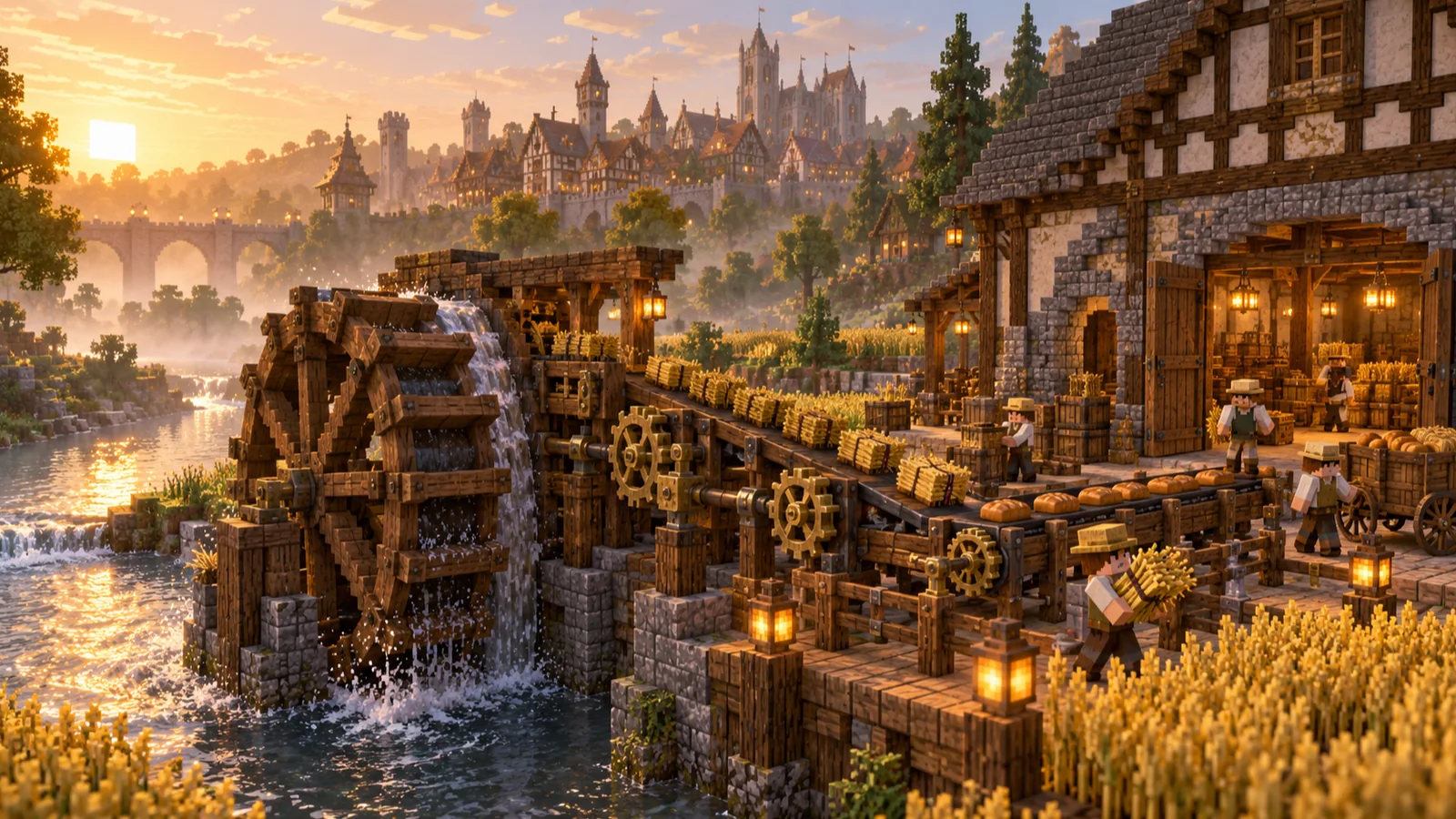
Welcome to the Kingdom. On Neody Legacy, a city that produces only what its citizens can carry by hand is still a camp. Your colony brings mouths to feed, requests and a warehouse; machinery brings water power, steam and belts. The two come together when production reaches the people who need it. This guide focuses on that connection: a useful production line, stock with a purpose and good habits for a mayor.
- Connecting colonies and machinery
- Machinery, railways, electrical equipment, decoration, food processing, power networks and maintenance
- Rotation
- Maximum speed of 256 RPM in the Kingdom
- Mechanical farms
- Recommendation: outside colony plots
- Founding
- More than 550 blocks from the world spawn point, up to 10,000 blocks
- Raids
- Roughly every 14 nights, with at least 10 nights between raids
- Maintenance
- Machines wear out: keep spare parts
What this connection involves
Owning a millstone does not make your colony self-sufficient. For the wider range of machines, the machinery guide covers generators, SU, boilers, moving assemblies and electricity. The getting started guide covers your Town Hall, Builder and the order of huts. Here, the question is how factory output reaches the Warehouse and reduces requests. Electricity and machine wear have their own guide: Energy and maintenance.
Before the first belt: get the colony working
Without a Warehouse and Courier, you have a factory and a pile of goods, with no connection between them. Revisit the order in the jobs guide if needed. Before automating, you need:
- A Town Hall placed within the founding limits: more than 550 blocks from world spawn, without exceeding 10,000 blocks.
- A working Builder, then a Tavern, food, wood and stone.
- A Warehouse and at least one Courier.
- A Presse-papiers (Clipboard) with you: your request dashboard.
- A Guard Tower under construction before the tenth night: hungry citizens and undefended walls make a raid twice as difficult. Read the raids guide.
Two machinery limits that can break the connection
Use Engineer's Goggles to inspect the network. Two figures are already covered in the machinery guide:
| Measure | Neody limit or rule | Why it matters |
|---|---|---|
| RPM | 256 | An overfast line drains its buffer and can overstress the network. |
| Moving assembly | ≤ 512 blocks | An oversized harvester will not move. |
| Mechanical farms | Recommendation: outside the colony | Inside, citizens and machines get in each other's way. |
| Wear | Machines wear while working | A worn machine loses efficiency, then breaks down and stops the line. |
| Overstressed | SU load > capacity | The entire line stops, and red cogs return to the colony. |
Fit a Stressometer before adding a second machine. A water wheel provides 256 SU at 8 RPM, enough for a first food line.
Your first useful line, step by step
Automate something your colony already requests. Wheat, wood and stone unlock building projects. Start with food: hungry citizens do not work, and basic food brings a happiness penalty.
The colony's request chain
Citizens follow a request chain, also described in the getting started guide:
- The worker looks in their hut.
- Then in the Warehouse, supplied by a Courier.
- Then with a crafter able to make the item.
- If nobody can provide it, the request comes to you as a red cog.
Tools for the mayor:
- Presse-papiers (Clipboard) : all requests, viewable remotely.
- Parchemin de ressources (Resource Scroll) : the current project; red means unavailable, green means in your inventory.
- Boîte postale (Postbox) : request what the colony stores or can produce.
Machinery supports steps 2 and 3: mass-produce what the crafter or Warehouse needs. A press does not replace a Blacksmith who lacks the recipes or level required. The different jobs are explained in the jobs guide.
Food: the line that changes your first week
Food-processing machinery, covered in the machinery guide, completes the chain:
- An automatically replanted mechanical farm outside the plot.
- Belts leading to a slicer with a knife inserted and sufficient RPM.
- A mechanical arm moving goods into chests.
- Delivery to the Warehouse, rather than a personal chest under the Tavern.
Seasons follow real-world time. One season lasts roughly a week, and a full year four weeks. Some crops grow better in different seasons: plan a backup farm. Read The wild world and the cooking guide.
Wood, stone and iron: the next three lines
Once bread is flowing, open the Clipboard and choose the most frequent request.
| Colony demand | First mechanical answer | Pitfall |
|---|---|---|
| Planks / sticks | Saw processing logs, one item at a time on Neody | The saw supports the Lumberjack rather than replacing them |
| Cobblestone / andesite | Drill on an assembly of ≤ 512 blocks, or a quarry outside the plot | Look in Andesite Crags for andesite |
| Ores | Millstone (raw → crushed + 75% chance of an XP nugget), then fan and water | Place the catalyst in front of the airflow and items in the airflow |
| Sheets / compacted goods | Press above a basin | Avoid filling the Warehouse with sheets nobody has requested |
The Precision Mechanism opens the way to brass and mechanical arms. Find exact recipes in the recipe browser withR; they are not repeated here.
Delivery: on foot, then by train
For the first evenings, you are the factory's Courier: a buffer chest, a journey and a deposit. When the factory, quarry and Warehouse are far apart, belts no longer suffice. Read the train guide : 28 blocks/s at cruising speed, 40 with a chest of coal (never a vault), with platforms near the Warehouse. A train needs fuel on board to move, and its controls wear like other machinery.
Address-based logistics also offers Packagers, Frogports, a Stock Ticker and Redstone Requesters. This is the machinery guide's advanced logistics chapter, rather than a task for evening 3. A colony of 20 citizens does not need a postal centre.
Maintaining the line: machine wear
A line running day and night wears its machines. On Neody, millstones, presses, mixers, saws, harvesters, deployers, water wheels and steam engines have wear bars. Efficiency eventually falls, smoke appears and the machine stops. A farm quietly stopping can turn into a red-cog request three days later.
- Monitor with the tooltip that appears when you aim at a block: aiming at a machine shows its condition and wear percentage.
- Repair by right-clicking with that machine's spare part: an iron sheet for a saw or harvester, andesite alloy for a millstone, a whisk for a mixer. Keep parts in the line's chest.
- Automate repairs with a maintenance drone station: it sends a drone to repair worn machines nearby while it has spare parts available.
What to buy at the start
The Neody shop replaces the former shop system. Use it as a safety net for the first days: buy a stack of bread to get through the night, then build the line. Prices are shown in game; this guide does not invent any.
Common supply problems
| Symptom | Actual cause | Remedy |
|---|---|---|
| Factory running, citizens still asking | Production stock never reaches the Warehouse | A buffer is not the Warehouse. Deliver the goods or bring a Courier to the deposit chest |
| Overstressed from machine number 3 onwards | SU load > capacity; load doubles with RPM | Add a Stressometer, another wheel or reduce speed |
| Harvester will not move | Assembly > 512 blocks, obsidian or collision | Reduce its size. This is the Kingdom's limit |
| Citizens get stuck in the farm | Farm built inside the plot | Move it outside the colony to keep citizens and machines apart |
| Useless millstone, red cog for bread | You automated something impressive rather than something requested | Read the Clipboard for requests |
| Builder stuck despite the factory | Request needs you, or Builder's Hut level is too low | Recall + Required Resources ; buildings cannot be upgraded above the Builder's Hut level |
| The line stopped and a machine is smoking | Wear: the machine is broken down or near the end of its life | Right-click with its spare part, or use a drone station |
| “My commands do not work” | /mc home and /mc rtp are disabled | Use travel stones, Town Hall level 3 alliances, your feet or your trains |
Supply connection FAQ
- Do I need machinery before a Tavern? No. Start with a Tavern, food for your people and a Builder. Machinery comes once the Warehouse exists.
- Is one water wheel enough? Yes, for a first line: 256 SU at 8 RPM. A windmill with 8 sails doubles that (512 SU).
- Can I put the farm beside the Town Hall? It is better to avoid it. The colony expands from 4 chunks initially to as many as 20: leave room.
- Can the mixer make potions here? Yes, this is enabled and covered in the machinery guide.
- Must I automate everything? No. Automate requests that return every morning.
- Will my machines run by themselves forever? No: they wear out. Plan spare parts or a drone station.
- What about classes and colony wars? For races and classes, read Origins and classes. For conflicts, alliances and routes between colonies, read War and peace. For defence against raiders, read Raids.
- Where are the exact recipes? In the recipe browser, press
R. The game provides the recipes.
Supply connection checklist
- Warehouse and Courier before the first belt
- Goggles and Stressometer on the network
- First line answers a real request, often bread
- Mechanical farm outside the colony, assembly ≤ 512 blocks
- Spare parts in the line's chest; aim at machines to inspect their tooltips
- Production buffer separate from the Warehouse
- Clipboard checked the next day: requests have decreased
- Guard Tower standing before night 10 begins
- Train only once belts no longer connect the sites
The water turns, the Warehouse fills and the red cogs disappear: that is when your production and colony become one working city of the Kingdom.
Read next: Getting started with your colony · Machinery · Trains for the Warehouse · Jobs guide · Raids · The shop · Combat · Origins and classes · Energy and maintenance