Neody
Relics and accessories: finding, equipping and keeping them
Camps, mimics, accessories, worn totems, jewellery, hats and graves: learn to find, equip and recover the Kingdom's relics.

Contents
A relic is more than another piece of armour. It occupies an accessory slot, changes how you play and can become a character's signature. Some improve mobility, others exploration, defence or gathering. You still need to know where to look, how to equip them and what happens to your accessories when you fall: a grave keeps everything.
- Main sources
- Structures, underground camps, chests, archaeological digs and unusual creatures
- Equipment
- Accessory slots, separate from ordinary armour
- After death
- Accessories follow your inventory into your grave
- Hats
- Cosmetics separate from functional relics
- Your origin powers
- Compare before equipping: see Origins and classes
Where to find relics
Relics are mainly found through exploration. Search structures, generated chests, underground camps and suspicious blocks at archaeological sites. Certain unusual creatures can also yield treasure. A long, well-prepared expedition generally brings more than waiting around near your base.
Underground camps
Look for light, small installations and signs of occupation in caves. Examine every chest, but secure the room first.
Structures and chests
Dungeons, ruins and inhabited places are natural targets. Light your return path and mark discoveries on your map.
Archaeology
Brush suspicious sand and gravel in pyramids, desert wells, ocean ruins and trail ruins. A relic may hide among the finds.
Unusual creatures
A rare enemy or living chest may conceal a relic. Prepare a fighting area before engaging.
For a distant expedition, bring food, torches, blocks, spare tools and a way home. The Travel and navigation guide explains how to combine maps, waystones and safe routes.
Going further with archaeology
Expanded archaeology adds the Brosse en Fer (Iron Brush) and Brosse en Diamant (Diamond Brush), plus a three-stage process: gather Fragments d'Artéfact (Artefact Shards) , assemble an Artéfact non Identifié (Unidentified Artefact) , then obtain an Artéfact Identifié (Identified Artefact) after examination. It also offers specialised totems such as the Totem des Torrents (Totem of Torrents) and Totem des Âmes (Totem of Souls). A natural companion to brushwork: every dig deserves a look, even when it yields no wearable relic.
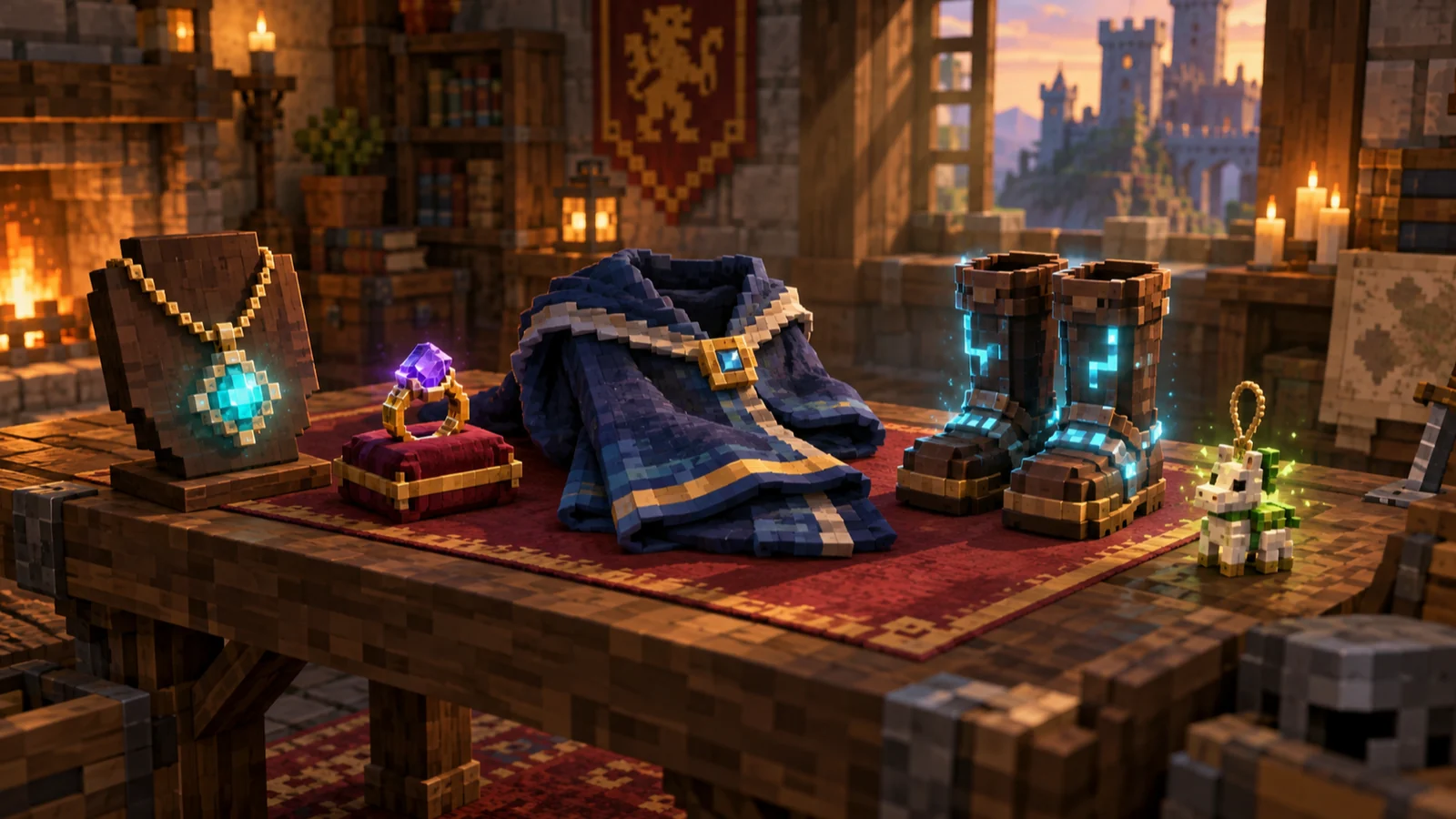
Recognising a good relic
Start by reading the full tooltip. It gives the effect, any conditions and the compatible slot. A spectacular relic is not automatically the best: the useful item strengthens what you actually do without taking a more valuable slot.
| Goal | Effects to prioritise | Question to ask yourself |
|---|---|---|
| Exploration | Mobility, vision, falling, swimming or climbing | Does it reduce a risk I often face? |
| Combat | Defence, evasion, recovery or control | Does it work with my weapon and class? |
| Gathering | Speed, reach, item attraction or yield | Does the gain justify the occupied slot? |
| Roleplay character | An effect matching the role and appearance | Can I fit it into my story without losing all effectiveness? |
Also compare the relic with your origin and class. A Fée (Fairy) already has free flight and no fall damage; a Gobelin (Goblin) already moves through shadows (ordinary monsters ignore them until struck, with a smoke bomb for escape); a Sirène (Siren) already excels underwater, including breathing and speed. Avoid spending a slot to duplicate a permanent power your people already possess.
Equipping a relic
Open your inventory, then show the accessory slots. Beside ordinary equipment, they accept items by category. Slots displayed in French are: Collier (Necklace), Anneau (Ring), Tête (Head), Dos (Back), Ceinture (Belt), Corps (Body), Bibelot (Trinket) (the charm), Mains (Hands) and Bracelet. A second accessory system coexists with the first and shows some slots in English (for example, Necklace, Charm, Shoes). Move the relic into a compatible silhouette; if it returns to your inventory, the slot type does not match.
If unsure, the item tooltip always states the expected category. An item meant for Collier (Necklace) will never fit an Anneau (Ring)slot, and vice versa: the simplest rule, and the cause of most rejected items in game.
1. Read
Hover over the relic, identify its slot and check its conditions.
2. Equip
Open accessory slots, drag the item to the correct silhouette, then close and reopen your inventory.
3. Test
Trigger the relevant situation, observe the actual effect and compare with your previous equipment.
Most passive relics work as soon as equipped and need no key. For an activated power, check the tooltip and keybindings in Options, then Commandes (Controls).
Other accessory sources
- Forged jewellery: rings and necklaces are made at the jewellery workbench using gems (ruby, sapphire, topaz, moonstone, peridot, onyx, garnet). They also occupy accessory slots (Anneau for rings, Collier for necklaces), and compete directly with found relics. The workbench appears in English (Jewelcrafting Station); search for this name in the recipe browser to see its recipe.
- The spellbook: a mage's spellbook occupies a dedicated accessory slot. Everything is in the spellcasting guide.
- The backpack: a portable bag goes in the back slot, freeing space and keeping replacement items close. See advanced storage.
- Masks and trophies: the samurai path's Oni mask is a full accessory, introduced in Combat and chivalry.
Wearing a totem as an accessory
Totem accessory support lets an ordinary Totem of Undying work from a compatible accessory slot. Put the totem itself in that slot (the Bibelot): there is no separate holder to fill. When it saves you, the equipped totem is consumed; place a fresh one before the next expedition.
- The totem no longer occupies your off-hand.
- Its slot remains occupied, so you give up another relic in that category.
- Each rescue consumes one complete Totem of Undying.
- Before a raid, boss or distant journey, visually check that the totem is still in its slot.
Recovering accessories after death
On death, a grave (the “Grave” block, displaying “Grave of” followed by your name) appears where you fell. It collects your inventory, and accessory support means your accessories go in too: amulets, masks and relics do not vanish. There is no corpse to search or revival by an ally on this server: the grave holds your belongings. Its in-game text remains English, with no French translation.
On respawn, you are invulnerable for 50 seconds (fall damage still applies): time to note where you must return. Your obituary (Obituary in game) records the name, location, dimension, date and items from every death, across several pages, with a button to copy the identifier. Remember one thing: mark the position before leaving again, including dimension and coordinates.
Returning to a grave
Note dimension and coordinates.
Take food, blocks and a spare weapon.
Deal with creatures around the grave.
Leave free inventory slots.
Check armour, off-hand and accessories.
Return each relic to its slot.
Building your set: four questions
Before filling every slot, ask four simple questions. They prevent carrying items you never use.
1. What activity?
Exploration, combat, gathering or building: a set for each use, rather than one set for everything.
2. What powers do I already have?
Your origin and class grant permanent powers. No need to pay for them again with an accessory.
3. Which slot is contested?
One Bibelot, one Collier: if the totem takes the Bibelot, another relic of that category must stay behind.
4. What happens if I die?
Your accessories follow your inventory into the grave. Keep a spare set in a chest so you can leave again immediately.
This habit is especially useful after death: finding a grave is easier when you know exactly what it contains. Record what you wore in your notebook, relic by relic.
Hats and appearance
Hats are cosmetics distinct from functional relics. They shape your silhouette, work outfit or guild uniform without replacing an accessory's powers.
Build a hat, distinctive armour and a visible relic around one clear idea: dwarf miner, druid apothecary, siren captain, mage archivist or goblin scout. A readable outfit beats a directionless collection of rare pieces.
Frequently asked questions
| Problem | Solution |
|---|---|
| The relic refuses its slot | Read its category in the tooltip and use the matching silhouette. |
| I cannot see accessory slots | Open your inventory and find the accessory button or area beside armour. |
| The effect does not trigger | Check that the item is equipped, its conditions are met and it needs no configured key. |
| My worn totem no longer works | Check the Bibelot slot. A rescue consumes the equipped Totem of Undying; you must then place a new one. |
| My accessories disappeared after death | Return to your grave, clear space and check every slot after recovery. |
| I cannot find my grave | Check your Obituary: location, dimension and date of each death. |
| A hat gives no bonus | That is normal for a cosmetic. Powers come from relics and functional equipment. |
A good relic does more than fill a slot: it makes your character more coherent, safer and more enjoyable to play, while your grave watches over the rest.