Neody
Combat and chivalry: weapons, armour, classes and graves
Directional combat, chivalric and samurai weapons, powered armour, higher-tier netherite, combat classes and graves: the complete Neody Legacy combat guide.
Contents
On Neody Legacy, you do more than click a pixel: you wind up a strike, chain combos and sweep through three skeletons with a claymore's backhand. When you fall, the Kingdom remembers: a grave keeps everything you carried. Directional combat, European chivalric weapons, the samurai path, powered armour, higher-tier netherite and combat classes: this guide covers the Kingdom's entire combat system, including how to return for your equipment.
- The system
- Directional combat: hit what the cursor aims at; the weapon's arc does the rest
- Arsenals
- European chivalric equipment and later additions, samurai weapons, powered armour and higher-tier netherite
- Your style
- Your class (Guerrier, Archer, Titan, Roublard): see Origins and classes
- Death
- A grave appears where you fall and keeps your inventory, including accessories; 50 s protection on respawn
- Recipes
- All in the recipe browser
Directional combat
Directional melee replaces vanilla combat with a sweeping, action-focused system: you strike what is in front of your cursor, with proper weapon collision detection. No more pixel hunting, and third-person combat finally becomes practical.
- Wind-up, then strike: each attack has a short wind-up. Feel it and learn to use it.
- Combos: each weapon follows a sequence of strikes with different angles and damage.
- Reworked sweeping: vanilla sweeping is disabled; instead, a swing hits several targets within the weapon's arc, with a progressive penalty as target numbers rise. The Sweeping Edge enchantment removes this penalty: a top priority for wide weapons.
- Dual wielding: equip two one-handed weapons and the attack key alternates hands for a faster attack rhythm.
- Two-handed weapons: halberds, claymores and similar weapons offer greater reach and arcs, but disable the off-hand: no shield while you hold them.
- Mobility: striking commits you, and an ongoing attack slows you down.
- Useful client settings (in the combat settings): feinting (cancel an attack during its wind-up, a PvP mind-game tool), holding click to chain attacks, target highlighting and the option to avoid mining with weapons.
- Striking through grass: attacks pass through tall grass and flowers rather than getting caught in them, one less concern during a duel in a meadow.
Your class: a fighter's first equipment
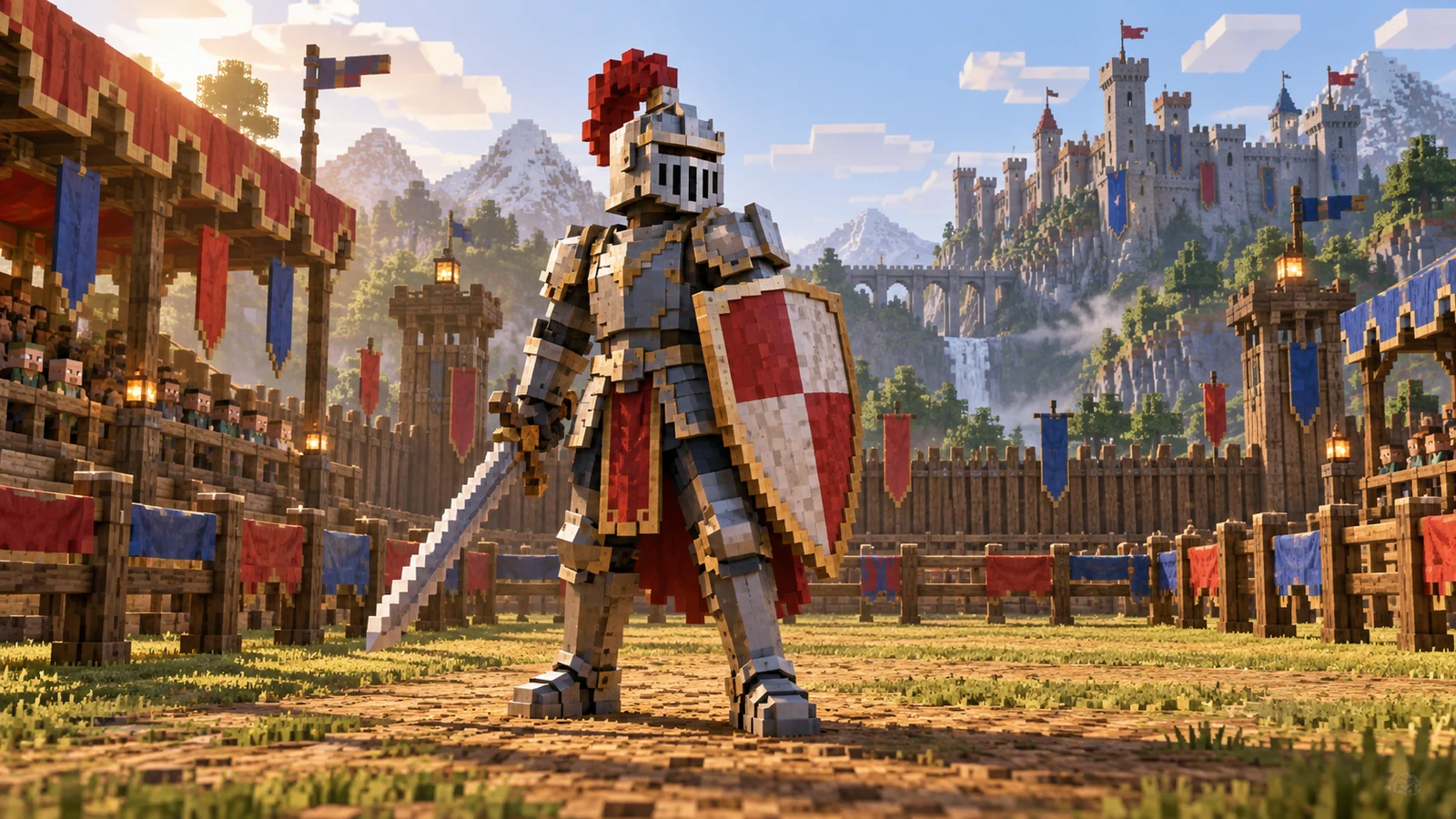
Before your first sword comes the class you confirm on your first login. It grants permanent bonuses worth as much as a piece of armour: full details (and all 25 peoples) are in Origins and classes. For combat, these are the four armed callings:
| Class | What it offers | The trade-off |
|---|---|---|
| Guerrier (Warrior) | More damage with every weapon, knockback resistance, natural armour, immunity to Weakness | Slightly slower movement |
| Archer | Perfect projectile accuracy, increased speed, better vision in dim light; you start with a Power I bow and a quiver | Reduced natural armour |
| Titan | Larger size, more health, greater reach, increased damage | Slower movement |
| Roublard (Rogue) | Invisible after sneaking for a few seconds, backstabs, parkour, reduced fall damage | Less health |
Each class also has a defensive reaction and a temporary stance, recharged at dawn, by a campfire or in bed. The principle: choose weapons that extend your class rather than work against it. A Rogue with a two-handed claymore gives up stealth; a Titan thrives with a heavy weapon. Values may change with balancing: your in-game class record is authoritative.
The knight's path: European chivalric equipment
The chivalric arsenal offers a broad selection of medieval European weapons in 11 materials (wood, stone, iron, gold, diamond, netherite, steel, copper, silver, tin, bronze), armour sets and shields. Further equipment spans the XIIIth to XVIth centuries.
Steel: the serious material
A recipe as straightforward as a blacksmith: smelt an iron ingot in a blast furnace to obtain a steel ingot. From it come plates, rings, mail and handles: intermediate parts detailed in the recipe browser. Your colony Blacksmith makes ordinary tools, but chivalric equipment is crafted by your own hands (see the jobs guide for the iron supply chain).
Choosing your weapon
- A balanced duel: bastard sword, messer, katzbalger; one-handed, with a shield possible.
- Reach: pike, ranseur, guisarme, knightly lance. Keep opponents at a distance at the cost of your off-hand.
- Against armour: estoc, war hammer, Lucerne hammer, morning star; weapons designed for plate (read each weapon's figures in its in-game tooltip).
- Spectacle: claymore, zweihander, flamberge. Big damage, imposing silhouette.
- At range: longbow and heavy crossbow.
Shields and heraldry
- From the discreet buckler to the pavise, which you can place on the ground as siege cover (gunners using siege machines will appreciate it).
- Heraldry: combine a banner with a shield, chestplate, helmet or horse armour in the crafting grid to decorate it; put the piece alone in the grid to remove the decoration. Some pieces can be dyed.
- Gilding and blackening: at the smithing table, use the piece + template + gold ingot (gilded) or black dye (blackened).
- Not craftable: some decorations are sold by wandering traders, banner patterns by shepherds, and chainmail horse armour is found in treasure chests.
The samurai path
The samurai arsenal offers a parallel path: mine jade, smeltsteel in a blast furnace (this steel coexists with the European variety without conflict), and forge a full Japanese arsenal: katana, wakizashi, odachi, naginata, kama, kunai, sai, tetsubo, throwing shuriken and yumi bow, each in steel then netherite.
- The spirit biome: Spirit Wood Forest generates spirit cherry wood, lanterns, guardian statues and spider lilies: the setting for your future forge.
- Yokai: ten spirits roam here, from Oni and Kitsune to Jorogumo, Akaname and Onibi (the full gallery is in the bestiary). Their trophies (Oni mask and horn, Kitsune hide, Akaname tongue, Jorogumo eye, Onibi flame) supply spirit smithing.
- Yokai katanas: fight spirits to upgrade your blades with their powers (Oni Katana, Kitsune Katana, Onibi Katana), using the Spirit Smithing Template. These are calledspirits (Spirit), not “souls”: rumours of a “soul system” are a misunderstanding.
- Wearable masks: the Oni mask goes in a dedicated accessory slot; read its effects in the tooltip. The Kitsune mask is equipped the same way. The relics and accessories guide explains the slots.
- Outfits: Samurai armour (steel and netherite), light Ronin, Ghost Samurai, Ninja, kimono and straw hat, with unique abilities unlocked through set upgrades.
Armour with powers
Around ten themed sets with 100% vanilla-material recipes (visible in the recipe browser), each with its own power:
| Set | Power | Typical use |
|---|---|---|
| Bois (Wood) | Good protection from arrows and explosions | Early protection against skeletons |
| Os (Bone) then Wither | Faster; skeletons ignore you; hurts attackers on contact, with the Wither variant applying Wither | Skeleton farms, night raids |
| Divine | Very high protection; full set can deflect a blow once per minute | Protection from sudden lethal hits (bosses, ambushes) |
| Lourde (Heavy) | Huge armour and toughness, almost no knockback, but no agility | Holding a breach |
| Slime | Attackers bounce back; greatly reduced explosion damage | Creepers, TNT, sieges |
| Guerrier (Warrior) | Higher axe damage; increased damage for every missing health point | An unabashed brawler's style |
| Robe | Fireproof, burns attackers, dyeable | Nether, roleplay mages |
| Steampunk | Hostile radar while sneaking, clock, double jump, no fall damage | Explorers, builders |
| Prismarine | Defensive spikes, built-in Depth Strider | Ocean monuments |
Recipes unlock when you collect the signature ingredient (bone, iron block, prismarine shard, slime, piston…). Enchanting, repairs and dyes work normally.
Beyond netherite: advanced tiers
Four tiers above vanilla netherite, forged in order at the smithing table (enchantments preserved): Netherite-Fer, then Netherite-Or, then Netherite-Émeraude, then Netherite-Diamant (Iron, Gold, Emerald, Diamond).
- Full-set powers: Iron makes Phantoms passive; Gold does the same for Piglins; Emerald for Endermen; Diamond combines all three (unless provoked).
- Tools: each tier mines faster than the previous one and vanilla netherite (read values in the in-game tooltips).
- Bonus drops: the tier's pickaxe can drop extra raw resources; the sword yields membranes from Phantoms, pearls from Endermen and gold from Piglins; the hoe improves wheat, carrot, potato and beetroot yields.
- No spears: the higher-tier netherite arsenal does not include them.
Fighting other players
PvP is enabled on Neody and follows rules. Against players, your arsenal serves in two very different settings:
Duels and quarrels: a directly aimed blow still hits. The Kingdom's rules cover griefing, protected territories and disputes.
Organised war: declaration, preparation, assault, truce. Colonies fight with their guards under precise rules. Everything is in War and peace.
Remember one golden rule: players cannot revive each other. When you fall, you die, and your grave takes over.
Dying on Neody: graves and safeguards
There is no bleeding-out stage or revival by an ally: on death, the grave system takes over. Here is what happens, in the order you experience it:
1. The grave appears
A “Grave” block appears at your death location, bearing your name and the date: “Grave of” followed by your username, “Died on” and the number of stacks inside. Grass, flowers and water give way; if placement is impossible, a message warns you (“Grave could not be placed”).
2. Everything is stored
Your full inventory, including armour and off-hand, goes into the grave. Accessory support means your accessories go in too: amulets, masks and relics are not lost.
3. You return for it
On respawn, you are invulnerable for 50 seconds (fall damage still applies): time to breathe and plan the return journey. Before leaving, note the dimension and coordinates.
4. You retrieve your equipment
Open the grave, take your items and check your armour, off-hand and accessory slots. Re-equip anything still missing. Clear inventory space before opening it.
The obituary: your record of deaths
TheAvis de décès (Obituary) is a booklet recording each death: Name , Location (coordinates), Dimension, Date and lost items (“Death Items”), across several pages. A button copies the death identifier to the clipboard, and “Location” gives you the details to send to an escorting friend. This guides your journey; it does not teleport you.
The totem accessory: before death
The best safeguard prevents the grave altogether. The Charme d'immortalité (Charm of Undying) allows an ordinary Totem of Undying to work from an accessory slot: put the totem in the charm slot and it saves you without occupying your off-hand, then is consumed. Details and other relics are in Relics and accessories.
Common mistakes & troubleshooting
| Symptom | Cause | Solution |
|---|---|---|
| Cannot raise the shield | Two-handed weapon in the main hand | That is the rule: switch to a one-handed weapon or accept the trade-off for reach |
| Damage drops against groups | Multi-target sweeping penalty | Enchant with Sweeping Edge to remove the penalty |
| Missing targets despite being close | Combat is directional: the cursor comes first | Aim at the target; the weapon's arc clears the surrounding area |
| Nobody can revive me after a fall | Revival by an ally is unavailable | Be careful, carry a totem in the charm slot and find your grave |
| “I cannot find my grave” | Coordinates not recorded | Check your Avis de décès: location, dimension and date of each death |
| “Grave could not be placed” message | No valid space at the death location | Report it on the Kingdom's Discord with the time and location of your death |
| An accessory is missing after recovery | Accessory not re-equipped, or full inventory | Clear slots, check the grave and return the accessory to its slot |
| The Oni mask does nothing | Carried in the inventory rather than the accessory slot | Equip it in its dedicated slot |
| No higher-tier netherite spear in the recipe browser | Spears are not part of this arsenal | This is expected: higher-tier netherite adds no spears |
| A player hit me with a directly aimed attack | PvP is allowed | That is part of play, but griefing has limits: protection and disputes |
The master-at-arms' FAQ
- Is dual wielding worthwhile? Yes: attack frequency increases. Two short blades, or a katana and wakizashi, work wonders.
- How do I make steel? Iron ingot in a blast furnace. The European and samurai arsenals each have their own steel, without conflict.
- Which armour is best? None universally: Netherite-Diamant for passive powers and statistics, Divine for protection from burst damage, chivalric plate for style. The choice depends on how you play.
- Do I lose my items when I die? No: they are in your grave, accessories included. Find it with your Avis de décès and empty it.
- Can a teammate revive me? No, that system does not exist here. Travel with company so someone can escort you to your grave.
- A samurai “soul system”? No: there are spirits (yokai), their trophies and the Spirit Smithing Template.
- Where can I see every recipe? Always in the recipe browser. The interface guide shows how to use it quickly.
- Which bosses can test my equipment? Tyros, the fire boss who grows stronger with every victory, and other elite threats: see the bestiary.
A complete fighter's equipment
A mastered main weapon (combo, reach, angle), with Sweeping Edge if it has a wide arc.
A decorated chivalric shield, or confidence with a two-handed weapon.
A situational powered armour set in storage (Slime, Steampunk…).
Netherite progression begun in tier order.
A Totem of Undying in the charm slot.
Your latest death coordinates recorded, or your Avis de décès with you.
Steel is forged in a blast furnace, warriors on the battlefield, and legends in the moment you return, unhurried and well equipped, to recover your grave.