Neody
Colony jobs: blacksmiths, farmers, lumberjacks and more
Builders, farmers, smelters, blacksmiths, couriers, guards and universities: the complete guide to colony jobs on Neody Legacy and how they differ from player classes.
Contents
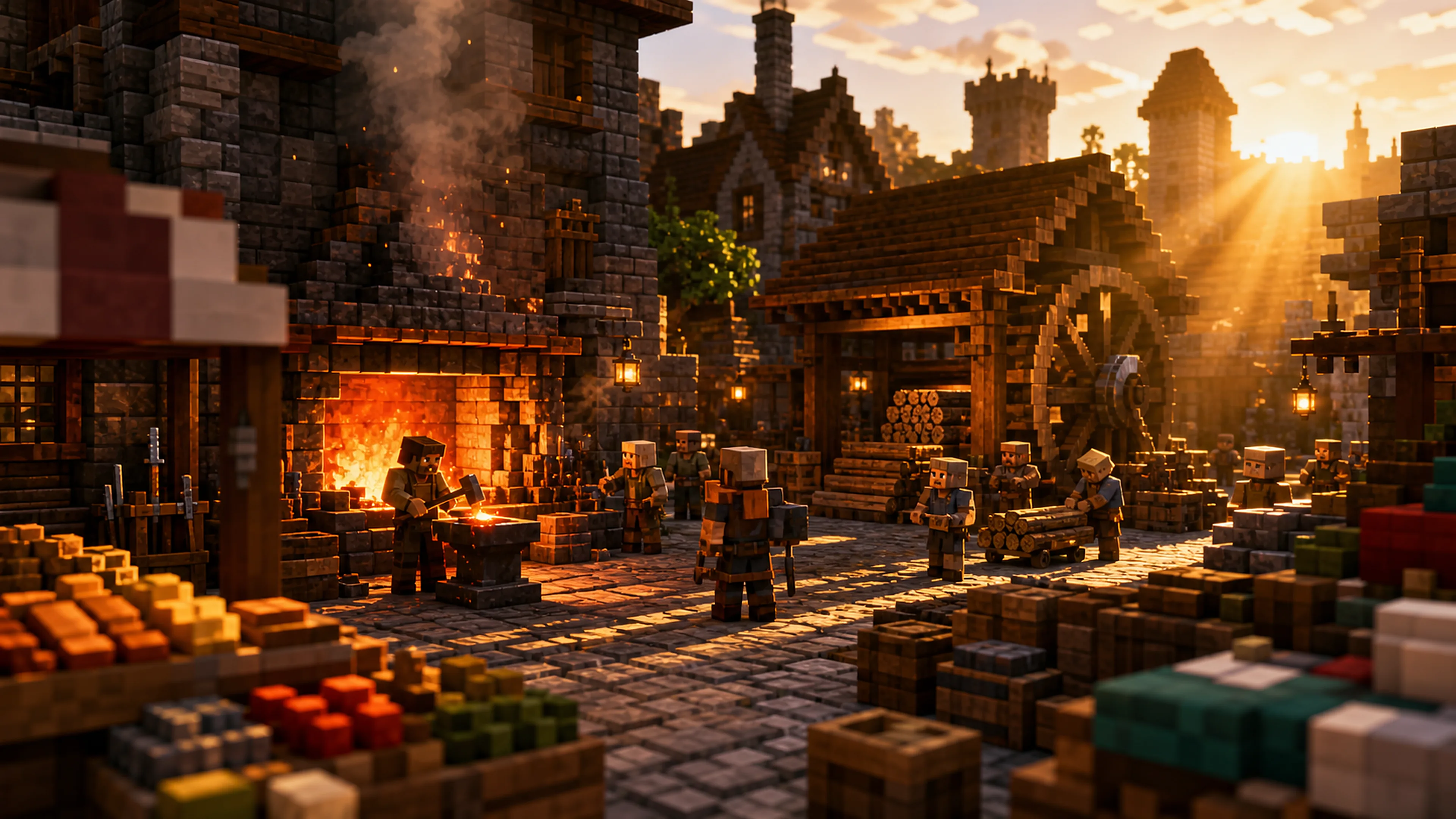
A colony is more than walls: it is people at work. On Neody Legacy, each colonist can become a builder, farmer, blacksmith, courier or guard, with their own skills, tools, requirements and little habits. This guide is your handbook for managing the Kingdom's workforce: how each job actuallyworks, how to develop your workers and how to unlock the production chains that keep a prosperous city running.
- The principle
- 1 hut = 1 job = 1 worker (except barracks, universities and warehouses)
- Progression
- Skills 1→99, capped by housing; huts at levels 1→5
- What drives it
- Automatic request system: every need travels up the crafting chain
- Requirements
- An established colony; otherwise, start with getting started
How a job works
Place a job hut with the Build Tool and have your Builder construct it. The colony automatically assigns a colonist, or you can choose one yourself through Gérer les travailleurs (Manage workers) in the building interface. Every hut interface shares the same controls: rename, Options de construction (Build options) (upgrade, repair, reposition), Rappeler le travailleur (Recall worker) (to recall a stuck worker), pickup priority, minimum stock and inventory.
- One worker per hut : build a second hut to work in parallel (two Builders = two simultaneous construction sites).
- Colonists work during the day : they rest at night.
- Every job has two traits : a primary and a secondary one. Recruit accordingly: a Blacksmith with high Strength works faster.
Skills: from apprentice to master
| Housing level | Skill cap |
|---|---|
| No housing (level 0) | 10 |
| Residence level 1 | 20 |
| Residence level 2 | 30 |
| Residence level 3 | 40 |
| Residence level 4 | 50 |
| Residence level 5 | 99 |
Progress depends on the workplace hut's level and the colonist's Intelligence (itself capped by the library). The lesson: proper housing for your workers is an investment in productivity. An artisan capped at 20 skill in a shabby level 1 home will never become a master.
The Builder: the keystone
Traits: Adaptability (placement speed) / Athletics (breaking speed). They build, upgrade and repair everything, and can only upgrade a building as far as their own hut's level. Blocks removed during construction are kept and deposited in their hut when the job is done.
- Track construction : use the Parchemin de ressources (Resource Scroll) or the Ressources requises (Required resources) tab: red = unavailable in the colony; green = in your inventory (↑ arrow to give).
- Work orders : listed in the Town Hall (Information, page 2), where you can prioritise or delete them; one active construction site per Builder.
- Building modes (after researching Modes du Bâtisseur (Builder modes)): Default, Hilbert (in sections), Inward Circle (a spiral, height 1 to 4) and Random (slower); the filler block is configurable (dirt by default).
Gathering jobs
The Lumberjack (Forester)
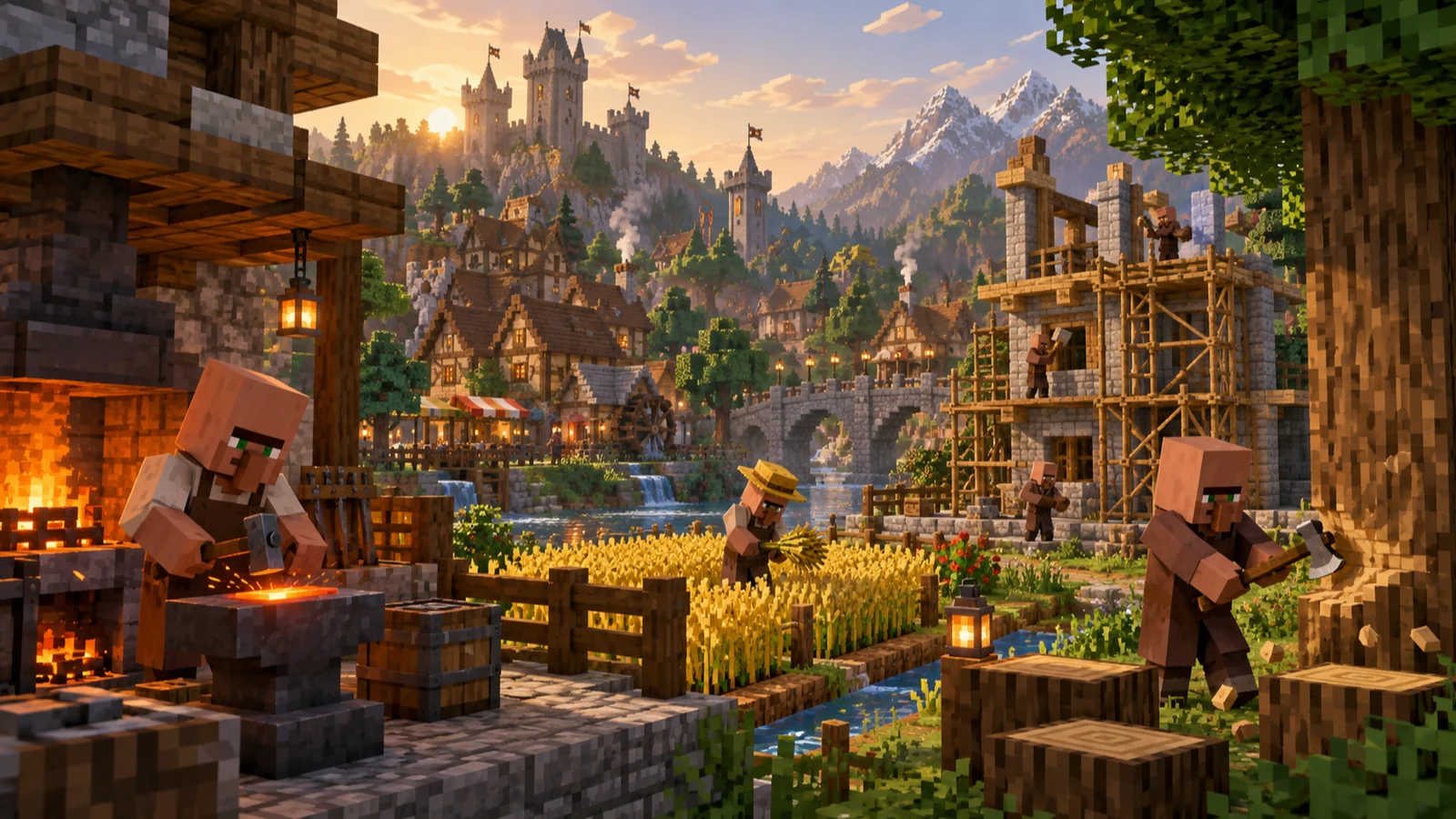
Traits: Strength (chopping) / Focus (movement). They fell trees within roughly 150 blocks of their hut, sparing trees planted on cobblestone and those used in buildings. Tools: axe and hoe (or shears if you enable “Use Shears”) for leaves.
- Useful settings : Replanting (replants when saplings are available), Break Leaves, the list of allowed saplings, and Zone mode with the Zone Tool: draw a 3D box including tree bases and foliage to define a precise logging area.
- Server limit : trees of up to 400 logs, so even giants are covered.
- Single-cut tree felling : the one-cut felling you enjoy as a player is disabled for non-player entities. Your Lumberjack works the old-fashioned way, methodically and without conflicts.
The Farmer
Traits: Stamina / Athletics. Tools: hoe, axe and seeds. Their fields use Field blocks (scarecrows) placed on farmland: choose the seed in the field interface. Fields extend up to 11×11 (5 blocks in each direction), and the number of fields follows the hut level (1 to 5).
- One action per field per day : tilling, planting or harvesting. The day/night cycle sets your farming rhythm; patience pays.
- Special colony crops : crops are distributed by biome (cold, temperate, humid, dry). High-tier dishes need ingredients from other climates: bartering between colonies soon becomes second nature.
- Real-world seasons : the server's seasons follow real-world time (roughly one week per season). Out-of-season crops grow slowly without dying: plan your fields by the week. Each seed's tooltip lists its fertile seasons; see the world guidefor details.
Fisher, Miner and your first food
- Fisher (Focus/Agility): the quickest food source for a new colony; the water does the work.
- Miner (Strength/Stamina): a steady supply of stone and ores.
- Later, the Quarrier (accessed through the Mine) excavates in bulk, while the Nether Miner sets off on infernal expeditions.
Artisans: the production chain
The Smelter
Traits: Athletics (number of furnaces, maximum 10) / Strength (speed). Their speciality: they apply Fortune to the ores they process, increasing with hut level, plus a chance to double or triple ingots at high levels. Your raw ores are worth more in their hands than in your furnace.
The Blacksmith
Traits: Strength (speed) / Focus (material savings). They craft on a 3×3 grid: vanilla tools, swords, armour and shields, but no bows or redstone components. Crucially: they know no recipes when hired. Teach them one at a time in the Enseigner une recette (Teach a recipe)grid, up to their limit: 10 / 20 / 40 / 80 / 160 recipes depending on hut level. At level 5, they automatically learn the 9 netherite recipes (which count towards the limit).
The full crafting network
All follow the same principle: taught recipes (limit 10→160), automatic requests and dedicated traits:
| Workshop | Speciality |
|---|---|
| Sawmill (Carpenter) | Wood and a large share of the intermediate items other huts request |
| Stonemason | Cut stone and decorative variants |
| Stone Smeltery / Brickmaker | Smelted stone, bricks |
| Glassblower | Glass and related products |
| Fletcher | Bows, arrows and your Archers' arsenal |
| Dyer, Mechanic, Concrete Mixer | Dyes, mechanisms, concrete |
| Crusher / Sifter / Composter | Rubble processing, sifting, compost |
| Alchemist / Enchanter | Potions; the Enchanter turns Ancient Tomes from raids into enchanted books |
| Animal keepers (chickens, cows, pigs, rabbits, sheep), Beekeeper, Florist | A steady supply of animal and floral resources |
| Baker / Chef (Cookery) | Baked goods; advanced dishes for higher tiers |
Cook and Restaurant: feeding everyone
At the Restaurant (Dining Hall), the Cook (Adaptability/Knowledge) cooks basic food in a furnace and serves it to hungry colonists, who come of their own accord. The Food list lets you exclude a dish from service. Colonists become more demanding as their comfort improves: the food quality they require rises with residence level, and vanilla food applies a happiness penalty. The full chain, Farmer → Chef → banquets, works wonderfully with the expanded cooking system, whose dishes also give players the Nourishment effect.
Warehouse and Couriers: the circulation system
The Courier (Agility = running speed, Adaptability = huts per round) requires at least a level 1 Warehouse. They deliver materials from the Warehouse to huts and collect their output on the return journey.
- Carrying capacity : 2 / 3 / 4 / 5 / unlimited stacks depending on their own hut's level.
- Number of couriers : 2 × Warehouse level (maximum 10 at level 5).
- Warehouse : central storage in Racks; level 3+: the Sort button (automatic sorting); level 5: capacity can be expanded with emerald blocks (maximum 3 times).
- Priorities : each hut has its own pickup priority (1 to 10 or never), plus the Demander un Ramassage Maintenant (Request pickup now)button. Deliveries from the Warehouse always come first.
- Minimum stock : each building can require a permanent reserve (fuel at the Restaurant, arrows at towers…). Set it up and the couriers take care of it.
Your personal storage is a separate craft: tiered chests, backpacks and a unified terminal.
Guards: three military callings
| Class | Equipment | Traits | Features |
|---|---|---|---|
| Knight | Sword required, armour; shield after the Évasion (Evasion) research | Adaptability = attack speed · Stamina = HP | Melee tank; the colony banner appears on their shield |
| Archer | Bow required; arrows consumed (+2 damage) after the Consomme des flèches (Consumes arrows) research | Agility = damage · Adaptability = range | Ranged damage; supply arrows through the Fletcher |
| Druid | Potions; magic potions after the Panoramix research | Mana · Focus | Support; no dedicated training building |
- Automatic equipment : each guard compares their equipment with the best available in their tower. If a piece is missing, a request automatically goes to your artisans or, failing that, to you.
- Equipment tiers by tower level : leather/gold at level 1, chainmail at 2, iron at 3, diamond at 4, netherite at 5; enchantments are capped in the same way.
- Role in war : your guards defend against more than raiders. To attack another colony, you need at least 3 guards, and each side commits at most 8 units ; rules, war bonds and truces are detailed in War and peace.
- Safe training : Combat Academy (Knights) and Archery Range (Archers); hire recruits directly from the building.
- Patrols : automatic hut-to-hut patrols (radius 80→200 blocks depending on level), or manual ones with the Sceptre de garde (Guard Sceptre), setting patrol points or a fixed post; use Follow mode for a bodyguard.
The complete defence strategy, including barracks, spies, military research and raid types, is in the raids guide.
The University: a boost for every job
The Researcher (Knowledge / Mana) conducts one research project at a time; a level N University employs N researchers, and column N of a tree requires level N. Costs are taken from your inventory when you start. Four branches: Civilian, Combat, Technology, Unlockables.
- Profitable first investments : First Aid (colonist HP), Circus/Festival (+5% happiness each), Builder Modes, Warehouse Master (stock prioritisation).
- Military chain : Tactic Training → Barracks → Improved Swords/Bows → academies → blocking, armour and damage bonuses.
- Level 3+ tip : time spent offline is partly converted into research progress (limited by the Researcher's Mana), so your real-world nights work for you.
- Column 6 : only one final research project can be active per branch; reversing it costs an Tome ancien (Ancient Tome), with no refund.
Colonists who speak, buildings with character
- Colonists' voices : your colonists speak in game and bring the city to life. Listen as you pass through a neighbourhood.
- Style blocks : building styles require decorative construction blocks (beams, panels, cladding…), made at theArchitect's Cutter. Stock the Warehouse before starting a styled build: without a block, a Builder stops, and their request appears in red.
- Two different “Tome ancien” items : the colony Tome ancien (Ancient Tome), found on raiders and used for research, is unrelated to the item of the same name found in world structures (see the everyday guide).
Optimising your workforce: the foreman's notebook
- Double up at bottlenecks : a second Builder when construction queues grow, a second Lumberjack when the Sawmill needs more wood.
- Priority 10 for the Restaurant and active Builders; never for inactive storage huts.
- Internal railways : your colonists only use a railway with at least 8 consecutive rails : short decorative lines serve no purpose.
- Short journeys : a colonist working more than 100 blocks from their bed complains (“living too far from work”); plan neighbourhoods accordingly.
- Library + school : Intelligence for adults, learning for children, the most underrated long-term investment.
Common mistakes & troubleshooting
| Symptom | Likely cause | Remedy |
|---|---|---|
| The Blacksmith crafts nothing | Recipe never taught, or recipe limit reached | Use the Enseigner une recette (Teach a recipe) grid; check the limit (10→160 depending on level) |
| A worker refuses a tool | Tool (or enchantment) tier too high for their hut level | Give them a suitable tool; upgrade the hut to unlock higher-tier tools |
| Under-equipped guards | A break somewhere in the Blacksmith/Fletcher → Warehouse → Courier chain | Trace the chain: recipes taught? Warehouse stocked? Couriers available? |
| Couriers standing still | Missing Warehouse, limit reached (2×level), or wrong warehouse assigned | Upgrade the Warehouse or reassign teams |
| A Farmer “doing nothing” | One action per field per day; they have already acted | Add fields; check the seed and current season |
| Colonist stuck at level 20-30 | Housing skill cap | Upgrade their residence (see the cap table) |
| Nobody eats at the Restaurant | Dishes disabled in the Food list, or quality too low | Re-enable dishes; improve food quality |
| Permanent “red cog” | A request no artisan knows how to fulfil | Hand over the item or put it in the Warehouse; teach the missing recipe |
The foreman's FAQ
- How many recipes can I teach? 10 / 20 / 40 / 80 / 160 depending on the artisan's hut level. The level 5 Blacksmith also receives the 9 netherite recipes automatically.
- Is the Smelter really worth it? Yes: Fortune (level − 1) on ores is a permanent wealth multiplier.
- Can I choose who does what? Yes, through Manage Workers in each hut; otherwise the colony assigns workers automatically (global setting in the Town Hall).
- Why is my researcher progressing so slowly? Research time is real time spent in game; several researchers do not speed up the same project. University 3+: your offline time partly counts.
- Can a colonist hold two jobs? No: one worker, one post. Only the University, Warehouse (couriers) and barracks towers have multiple posts.
- How do I get a Tome ancien (Ancient Tome)? From the bodies of raidattackers; the Enchanter also uses it to make enchanted books.
A smoothly running colony:
- Builder level 2+ before everyone else, with residences keeping pace with skills
- Fisher, then Farmer, with fields suited to the biome and season
- Upgrade the Smelter quickly for Fortune; teach the Blacksmith recipes
- Warehouse + couriers before huts overflow
- Minimum stock set for fuel, arrows and food
- University underway: First Aid, Circus, then the military branch
Skilled hands, a full warehouse and a university working late: that is what great cities are made of.