Neody
War and peace: diplomacy, wars and raids
Treaties, alliances and vassalage, war declarations, assaults, raids, espionage and trade routes: a complete guide to Neody Legacy's Guerre & paix tab.

Contents
On Neody Legacy, colonies talk, sign treaties, swear allegiance, dispute borders and sometimes declare war. Everything happens in one place in game, the Guerre & paix (War & Peace) entry in the K menu. This guide explains how to read that screen, which agreements exist, how war unfolds from declaration to truce, and how raids, espionage and trade routes work, with all the figures to know before committing a single denier.
- Access
- Press K › Monde › Guerre & paix (directory, colony file, then Guerre or Salle de guerre)
- Who decides
- The colony leader signs and declares; officers view and prepare
- War bond
- 500 to 50,000 D, required from both sides
- Approval
- The staff review every declaration within 24 hours
- Commands
- None: everything uses the screens

Using the Guerre & paix screen
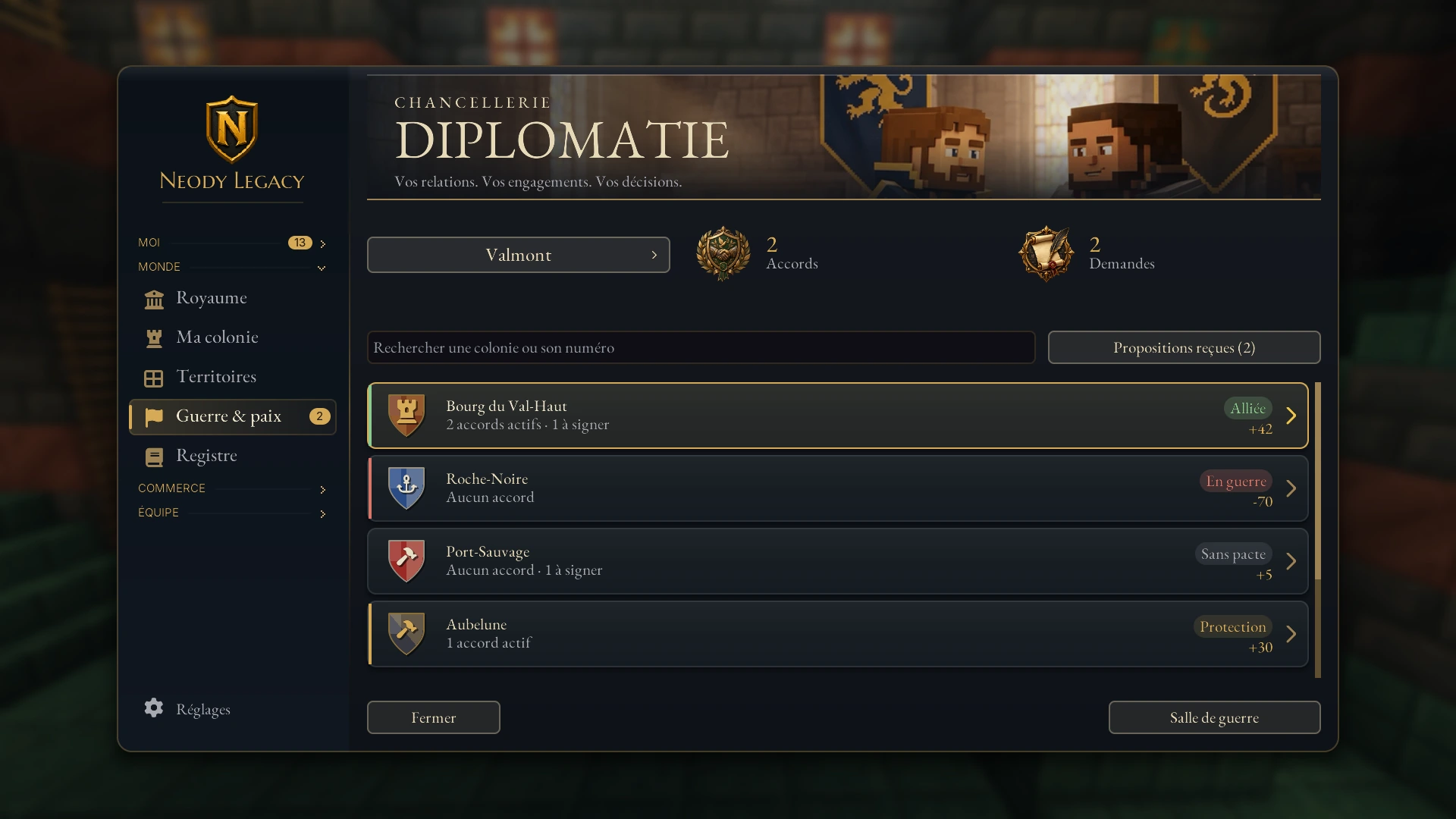
Open K › Monde › Guerre & paix. The directory lists colonies; choose one to open its file. You will find its Accords (Agreements) and Chronique (Chronicle), with the Guerre (War) and Routes entries. Nouvel accord (New agreement) and Préparer un raid (Prepare a raid) start the relevant journeys. Proposals awaiting signature are in Propositions reçues (Received proposals).
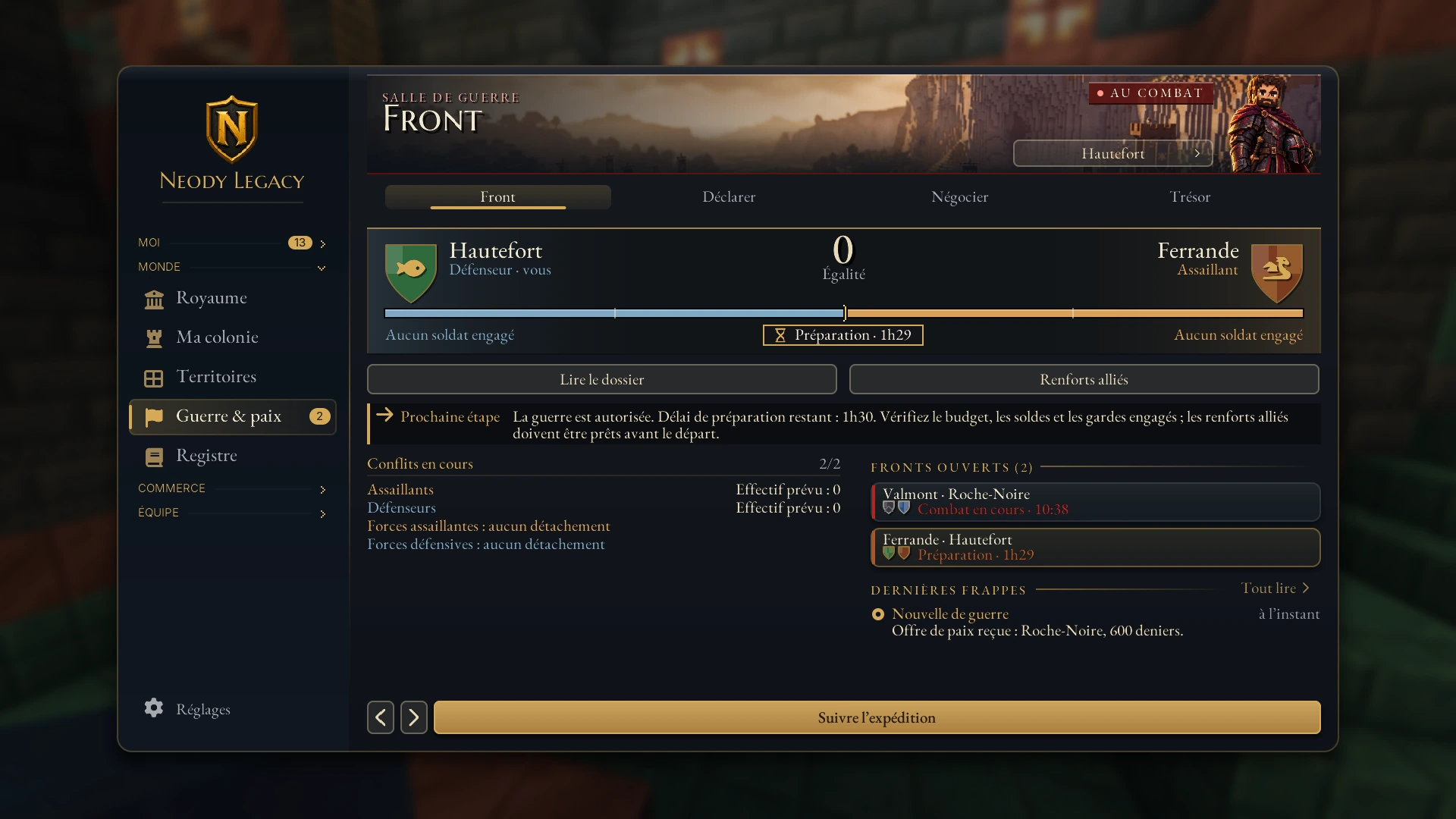
The war room brings together Front, Déclarer (Declare), Négocier (Negotiate) and Trésor (Treasury). Front tracks conflicts. Additional tools depend on your rights. The file explains what is available to your colony and what prevents an action.
Diplomacy: nine agreements for nine needs
Propose an agreement from the Diplomatie screen. The recipient finds it in Demandes reçues (Received requests) (“Propositions reçues”, with their count) and signs using Signer cet accord (Sign this agreement). They must sign within 2 days or the proposal lapses. The agreement's duration begins only on signing; choose 7, 30 or 90 real-world days.
| Agreement | What it does |
|---|---|
| Pacte de non-agression (Non-aggression pact) | No war between the two colonies. |
| Alliance militaire (Military alliance) | No mutual attacks; reinforcements for attack and defence; trade routes open. |
| Accord commercial (Trade agreement) | Allows trade routes between your portcullises and the other colony's, without a deduction. |
| Libre circulation (Free movement) | Formalises an agreed passage between colonies (no specific gameplay effect). |
| Accord portuaire (Port agreement) | Formalises agreed access to the other colony's ports (no specific gameplay effect). |
| Pacte défensif (Defensive pact) | Each signatory defends the other if attacked; no attacks between signatories. |
| Vassalité (Vassalage) | The proposer becomes overlord. The vassal pays daily tribute (which may be zero) and may commit to helping their overlord or declaring no wars. |
| Tribut (Tribute) | The proposer pays an amount to the recipient colony each day. |
| Garantie d'indépendance (Guarantee of independence) | One-way protection: the guarantor defends the guaranteed colony. |
What really protects you: protective agreements
Five agreements prevent ordinary war declarations between their signatories while active: non-aggression, military alliance, defensive pact, vassalage and guarantee of independence. Trade, free movement, port and tribute agreements do not prevent war.
Relations between colonies
Each pair of colonies has mutual opinion, from −100 to +100. Signing adds 10 points (at most once per 7-day period); breaking an agreement removes 20, declaring war 35 and raiding 20. Labels range from “Alliés éternels” (Eternal allies) to “Guerre totale” (Total war), through “Amicaux” (Friendly), “Bons termes” (Good terms), “Neutres” (Neutral), “Relations tendues” (Strained relations), “Hostiles” (Hostile) and “Ennemis” (Enemies). Combat between individual players does not affect this scale.
Declaring war
War never starts automatically: a declaration is filed, reviewed by the staff and then opened. Here is the full journey in the war room's Déclarer tab.
1. Choose grounds for war
Select from the grounds the game offers (listed below) and write public text of 12 to 4,096 characters. The staff and opponent will read it, so take care: it is your case.
2. Review and submit to the staff
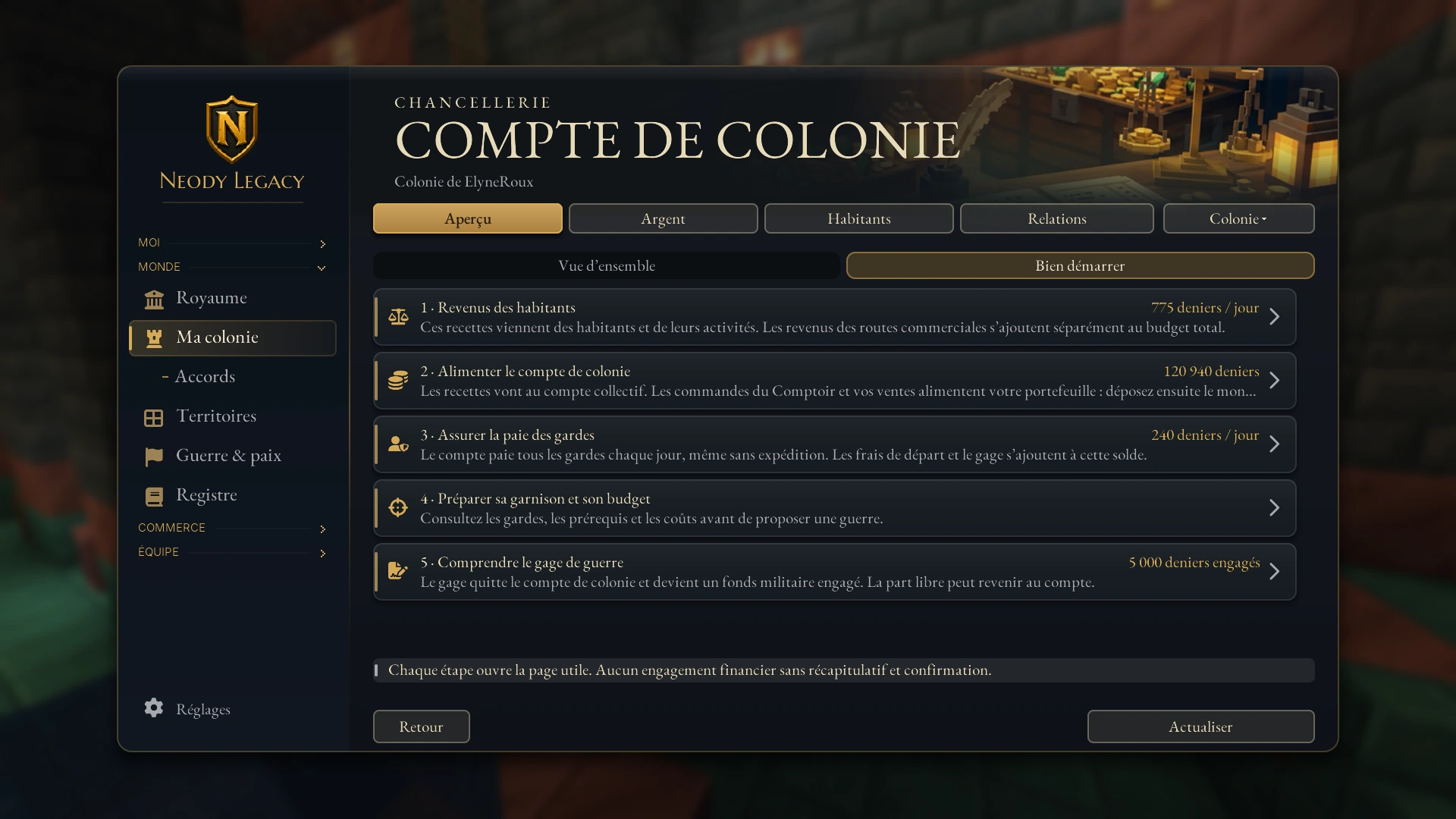
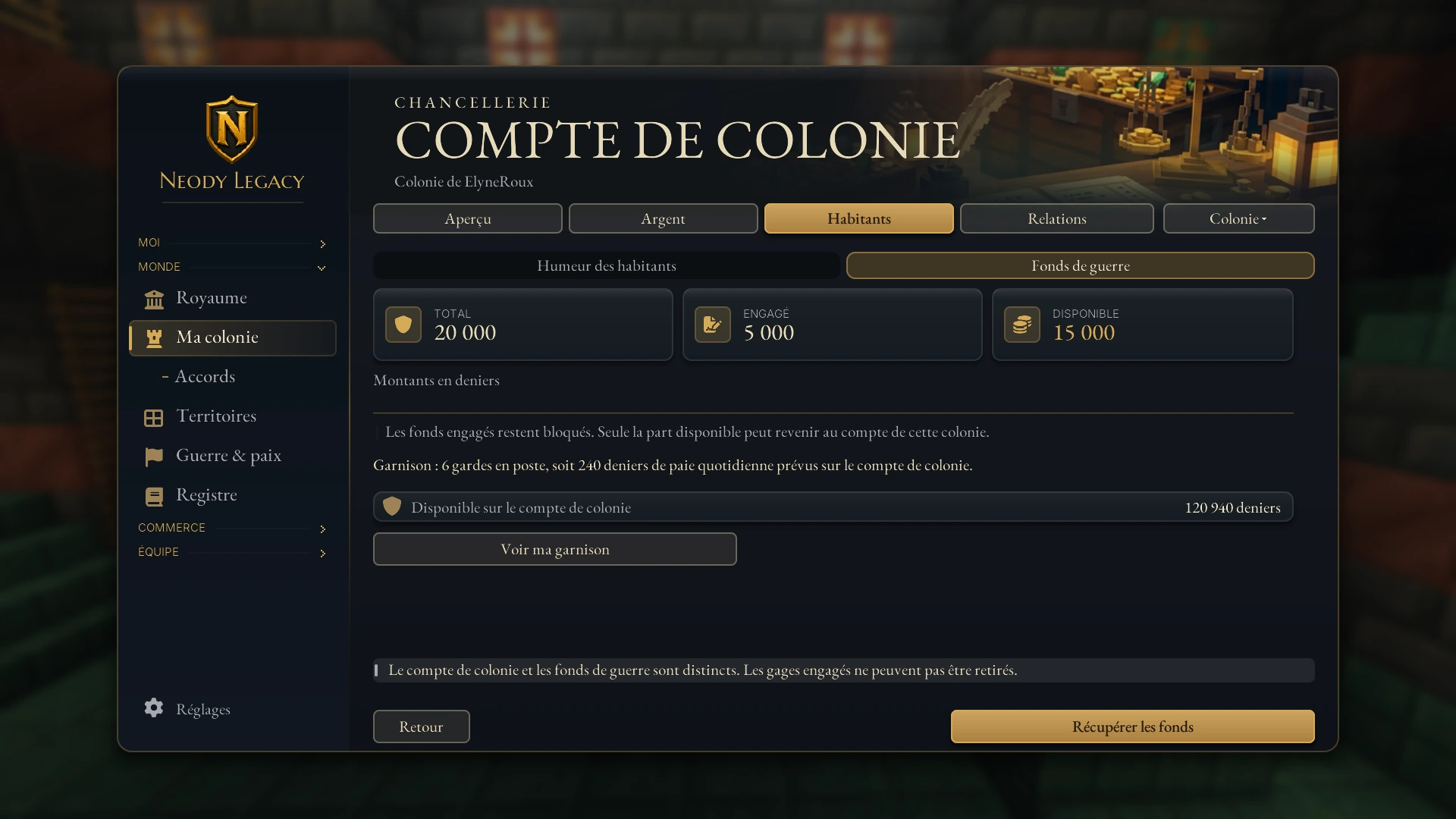
The game proposes a bond rather than asking you to enter one: a quarter of your colony's war reserve, limited to between 500 and 50,000 D. Both sides must provide the same amount, taken from each colony's current account. Review it, then send with “Soumettre à l'équipe” (Submit to the staff).
3. Await the decision (24 hours)
The staff approve or refuse within 24 hours. Only your side is notified at this stage; your opponent learns of the war only on approval. The attacking leader must be online for approval. Refusal always comes with reasons. After 24 hours without a decision, the file closes and bonds are returned.
4. Preparation (5 minutes)
On approval, both bonds are frozen and a 5-minute preparation phase opens: gather your garrison. Peace can already be negotiated at this stage.
5. The battle window (7 days)
War is open and you have 7 days to launch the assault. Without an assault in that period, war closes, bonds are returned and there is no verdict or truce.
What the game checks before accepting your case
- No current truce with the target.
- The target is another colony, led by another leader, in the same dimension as yours.
- No protective agreement or post-break protection between you, and no war already open between the colonies.
- If you are a vassal with “offensives interdites” (offensive wars forbidden), you cannot declare war on anyone.
- Only one pending case per pair of colonies; both colony accounts must cover the bond.
The nine available grounds
Conquête totale (Total conquest). Defeat the garrison or open a decisive breach. The only grounds allowing buildings to fall and the colony to be erased: only this allows sappers and demolition.
Vengeance (Revenge). Defeat the opposing army. Buildings are spared; bonds are settled according to the verdict.
Guerre de réparation (War for reparations). Claim 1 to 10,000 D: victory takes this from the opposing account, after wages owed.
Vassalisation (Subjugation). Impose vassalage on a free colony with a Town Hall, or increase tribute from a vassal who has not paid after an ultimatum. Objective: hold the Town Hall.
Guerre de succession (War of succession). Remove a colony's leadership (the target must have a built Town Hall): on victory, leadership changes hands, but buildings, residents and account remain.
Revendication territoriale (Territorial claim). Claim a building-free plot of 16 × 16 blocks on the shared border. Objective: hold its centre.
Violation d'un traité (Treaty violation). Requires a signed treaty, active or ended no more than 30 days ago. Victory ends that treaty.
Guerre d'indépendance (War of independence). Reserved for a vassal against their overlord: victory breaks the agreement and stops future tribute.
Guerre pour dette (War over debt). Requires an unpaid loan or tribute with an expired ultimatum. No demolition; recovery is limited to the debt and available funds.
For grounds requiring a location to be held (subjugation, succession, plot), occupation must last 60 uninterrupted seconds: at least one attacker within 12 blocks, no defender within 16 blocks.
How an assault unfolds
Launch conditions
The attacking leader launches the assault, once per war. You need:
- a barracks built and at least 3 guards;
- the defending leader online (the defender needs neither a barracks nor a minimum guard count);
- enough colony funds for departure costs, with garrison wages up to date;
- no more than 2 simultaneous assaults across the server: if both slots are taken, wait your turn.
Armies and the battlefield
Each side fields at most 8 units from its guards. Soldiers fight by themselves: you command and observe, and losses are real. In Conquest, up to 2 of these units are sappers: they demolish walls. Under all other grounds, they fight as line soldiers.
The assault follows a precise sequence: armed, gathering (30 seconds), marching (20 to 180 seconds depending on distance), deployment (10 seconds), combat, then retreat (30 seconds). If nothing happens for 120 seconds (neither death nor breach), the army retreats. The defender is warned as soon as the assault is armed.
“Voir la bataille” (Watch the battle) opens an observation camera: overview, following a soldier or highlights. Échap (Escape) returns you to your position. During war, an on-screen display shows progress, for example “Rempart x/y” (Wall x/y) in Conquest.
Sappers, demolition and decisive breach
In Conquest only, demolition removes blocks within a radius of 3 around sappers, up to 240 blocks per assault. If 60 blocks are demolished with at least one attacker still alive, this is a decisive breach: the attacker wins. What falls stays fallen; peace rebuilds nothing.
The verdict
In Conquest, if one side has no survivors, the other wins; a sufficient breach gives the attacker victory; otherwise, most survivors wins, with ties going to the defender. For grounds requiring the opposing army's defeat, the attacker wins only if no defender survives. For holding objectives, occupation must succeed with at least one survivor. A score builds during combat (assault won, units killed, breach) and determines the scale of victory: below 10 points, war has no winner.
After combat: reparations, peace and truce
When the assault ends, war enters resolution: a verdict is delivered, bonds are settled and a 24-hour truce begins between the colonies. During the truce, neither can declare war on or raid the other.
- Reparations. The winner receives at most 25% of the loser's bond, adjusted by the scale of victory. The remainder of each bond returns to its owner. Departure costs are never refunded.
- Negotiated peace. From preparation until war ends, the Négocier (Negotiate) tab lets you propose peace. White peace (zero deniers) is always possible. Demanding reparations requires a lead of at least 25 war points, and the side that did not propose always pays. An offer lasts 24 hours; a new proposal replaces the previous one as a counter-offer. Losses remain permanent.
- Case refused, time limit exceeded or battle window missed. Bonds return and there is no truce.
Raids, espionage and trade routes
Raids: striking without war
A raid is a quick guard expedition against another colony: no case to submit, no bond and no building destruction. The leader prepares and launches it (“Préparer un raid”); members view it. It requires a barracks and 3 to 8 available guards, costing 750 D plus 125 D per guard.
| Condition or effect | Value |
|---|---|
| Target | At least 5 residents, another leader, same dimension. Defending leader online for a player colony; this requirement does not apply to a colony requisitioned by the Kingdom. |
| Forbidden during | A truce, protective agreement, war or another active raid |
| Time between raids on the same target | 24 hours |
| Denier loot | 20% of the target treasury, at most 10,000 D |
| Item loot | 20% of stock, at most 1,024 items |
| Delivery | K menu › Moi › Livraisons |
Raids against requisitioned colonies
Read the file's status before preparing the expedition. Raiding a player colony and attacking a requisitioned colony have different conditions. A raid remains a guard operation without war declaration, bond or building demolition.
Against a requisitioned colony, defence adapts to both colonies' strength. The file may refuse departure if you are too weak and shows the threat: do not rely solely on visible guard numbers.
Loot is taken only on victory. A raid creates no truce, removes 20 opinion points and disrupts the target's trade routes for 24 hours.
Reinforcements
An ally bound by a military alliance, defensive pact, guarantee or vassalage may send their own guards (defence only for a defensive pact) into an authorised war before the assault launches: at most 8 guards per detachment, one detachment per colony per war, with at least one guard staying home. Costs (750 D + 125 D per guard) and wages remain the assisting colony's responsibility.
Espionage: know before acting
The leader can recruit a visitor to observe another colony. Three options, paid upfront and never refunded:
| Mission | Price | Duration | What the report reveals |
|---|---|---|---|
| Reconnaissance | 25 D | 15 min | Resident and guard count ranges, workshops spotted |
| Infiltration | 50 D | 30 min | Exact numbers and defence levels |
| Infiltration longue (Extended infiltration) | 100 D | 1 hour | All the above, plus money, main stocks and treaties |
Time counts only while your visitor is within 48 blocks of the observed colony's centre. Each colony has at most 2 active missions, one per target. Counter-espionage: if you spot a suspicious stranger, question them within 6 blocks: they are exposed, their mission ends and their employer is revealed in 40% of cases.
Trade routes: profitable peace
Two colonies, each with a portcullis linked to the other's, and bound by a trade agreement, alliance, vassalage or the same leader, open a route. Each then receives 100 D per level of the smaller portcullis per 24-hour period of uninterrupted opening. Each leader sets a toll of 0 to 20% on their partner's gross income and can close or reopen trade in “Routes commerciales” (Trade routes). Changing the toll or opening resets the period.
Pitfalls and chancery advice
No beginner protection. The system grants new colonies no specific war immunity. Target, requisition and strength conditions in the file still apply. The important thresholds: a target of at least 5 residents for a raid, 3 guards and a barracks to attack.
Sign before fear sets in. A non-aggression or defensive pact signed in peace costs little and blocks declarations. Do not rely on a trade agreement for protection.
Plan around being online. The leader must be online for declaration approval, and the defending leader for an assault to launch. Arrange your times.
Do not empty your account. Bond, departure costs and guard pay come from the colony account. Consult “De la colonie à la guerre” before filing a case.
Messages follow. The received declaration, seal and verdict also arrive in your mail; the armed assault, breach and peace produce on-screen notices. If you were offline, a summary awaits on reconnecting.
Before declaring war
My grounds are valid and my public text has 12 to 4,096 characters.
No protective agreement, truce or post-break protection with the target.
I have a barracks, at least 3 guards and their wages are up to date.
My account covers the bond, departure costs (750 D + 125 D per unit) and pay.
I am online for staff approval (within 24 hours); I know the defending leader must be online for the assault.
I know that in Conquest, what falls is not rebuilt.
To understand the deniers moving through these agreements, read Deniers, the currency of the Kingdom; to discover the rest of the menu, The Neody menu.
A kingdom is judged by its treaties as much as its walls: sign before striking, and strike only after counting every cost.