Neody
Automation and mechanical engineering
Water Wheels, steam, trains, circuit electricity, machine maintenance, automated cooking and schematics: Neody Legacy's complete machinery guide.
Contents
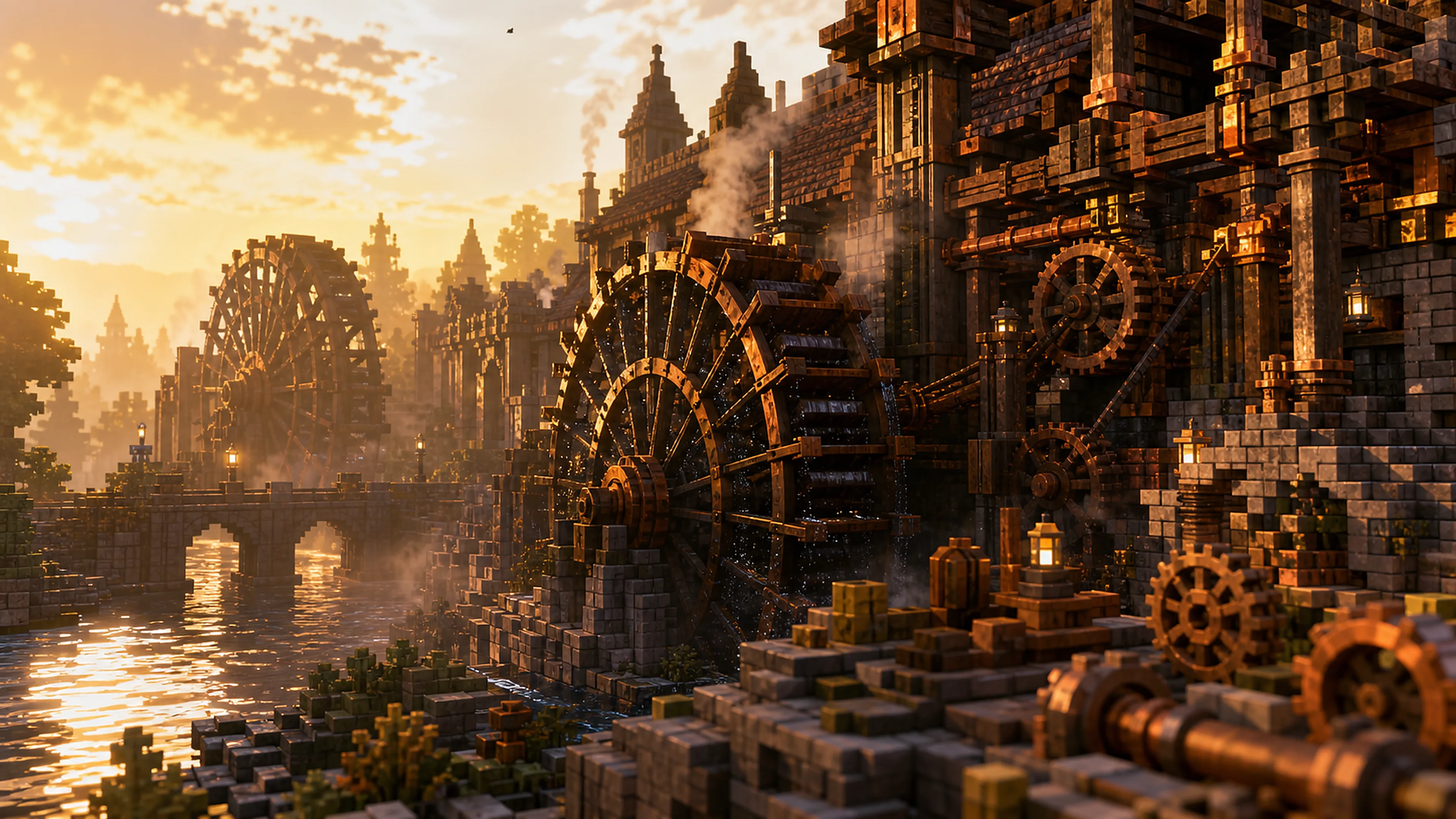
Build your Kingdom with your own hands, or harness water, wind and steam. Mechanical engineering turns the world into a workshop: roaring water wheels, belts carrying ore, articulated arms preparing food for the colony and trains connecting cities. This guide takes you from a hand crank to a steam factory, covering electricity, maintenance, railways, food processing and industrial decoration.
- Type
- Engineering and automation
- Difficulty
- Progressive, with forgiving andesite beginnings
- Key resources
- Andesite, copper, zinc → brass
- Favourite tools
- Clé (Wrench) and Engineer's Goggles
- Kingdom limits
- Moving assemblies ≤ 512 blocks, rotation ≤ 256 RPM
- Maintenance
- Machines wear: inspect their tooltips and repair by hand or drone
Rotation and stress: two engineering principles
Machinery uses two main measures, always readable with Engineer’s Goggles :
- The rotation speed in RPM, capped at 256 RPM in the Kingdom. It determines machine speed.
- The Stress Units (SU), representing network load. Generators provide capacity and machines add load, which doubles when their speed doubles. If total load exceeds capacity: Surmené (Overstressed)appears and everything stops.

Generators, from stream to boiler
Your goggles show these figures:
| Generator | Speed | Capacity | Good to know |
|---|---|---|---|
| Hand Crank | 32 RPM | 256 SU | Works while you turn it, building up hunger |
| Water Wheel | 8 RPM | 256 SU | Water must be flowing across the wheel's plane; right-click with planks to decorate it |
| Large Water Wheel | 4 RPM | 512 SU | 3×3 structure: slow but powerful |
| Windmill (Windmill Bearing) | 1 RPM / 8 sails (maximum 16 RPM) | 512 SU / RPM | Minimum 8 sails; 128 sails = 8,192 SU |
| Steam Engine | Depends on boiler | Depends on boiler | See below |


The boiler, a mid-game powerhouse
Combine fluid tanks, Blaze Burners and Steam Engines for a dependable power plant. Larger boilers with enough heat and water produce more power. Inspect the boiler tooltip or use goggles to read its level.


Transmission: shafts, gears and belts
Use shafts to carry rotation in a straight line. Cogwheels turn it through 90°, and small-to-large pairings double or halve speed, forming your gearbox. Belts with a reach of up to 20 blocks carry rotation and items. To supply 256 RPM without a tower of gears, a Rotation Speed Controller sets the speed precisely.


The basic workshop: six versatile machines
- Millstone : grinds raw ores and grain. Crushing raw iron ore also gives a 75% chance of an experience nugget.
- Press : makes sheets and compacted ingots. Above a Basin, it compacts single-ingredient 2×2/3×3 recipes.
- Mixer and Basin : mix ingredients. On Neody, the Mixer also brews potions and accepts shapeless recipes. Heating the Basin with a burner also cooks its recipes.
- Saw : turns logs into planks and cuts like a stonecutter. It processes one item at a time here, rather than a whole stack.
- Drill : breaks blocks in front; mount it on a moving assembly for tunnel boring.
- Fan : blows through a catalyst. Water washes crushed ores into clean metals, lava smelts, and soul fire performs haunting. Put items in the airflow.


A key mid-game component is the Mécanisme de précision (Precision Mechanism), assembled over several passes on a Depot using a Deployer and parts. Every exact recipe is in the recipe browser; press R on a machinery item.

Logistics: moving items automatically
- Chutes and funnels use gravity and extraction to supply lines.
- Mechanical Arm : reaches up to 5 blocks, supplying Millstones, Presses and Basins through chosen input and output points.
- Address-based logisticspackages orders into parcels with Packagers, sends them by Chain Conveyors to addressed Frogports and manages everything through a Stock Ticker and Redstone Requester that orders missing goods automatically. Your organised storeroom becomes a postal sorting centre.


Moving assemblies: bringing buildings to life
Join blocks with Super Glue or chassis and move them with: Mechanical Bearings for rotation, Mechanical Pistons with up to 64 extensions, gantries for precise movement, pulleys for vertical movement, including a proper lift with floors and an arrival bell. Remember the Kingdom's limits: maximum 512 blocks per moving assembly; obsidian and reinforced deepslate cannot move; spawners can move but cannot be collected.

Trains: connecting the Kingdom's cities
The railway system includes basic tracks plus additional railway options: narrow, wide and monorail tracks, many wood varieties, semaphores, bogies in many sizes, chimneys, buffers, a handcar and locométal bodywork. Your first route is explained fully in Trains for the Warehouse ; here are the essentials.
- Laying track : segments up to 32 blocks, with stations, signals and track observers at crossings.
- Assembly : at a station, enter assembly mode and add a train frame, bogeys (20 maximum) and required Contrôles de train (Train Controls) . Maximum assembly length: 128 blocks.
- Speed : 28 blocks/s cruising, 14 on curves. A powered train reaches 40 blocks/s. Manual driving is limited to 75%.
- Fuel : on Neody, trains require coal, bioethanol in a tank or bucket, or lava on board. Without it, Ce train est à sec says the train is out of fuel. Make bioethanol in a Mixer using sugar, cinder flour and biomass in a Basin. A liquid burner uses it to heat Basins and boilers; trains gain roughly 20% speed and a quarter less wear.
- Timetables : use schedules to automate stops and conditions and deliver packages from addressed logistics as railway postal freight.
Converting rotation to electrical energy
The FE electrical equipment converts motion into FE energy and back:
- Alternator : rotation → electricity at 75% efficiency, up to 360 FE/t at 256 RPM.
- Electric Motor : electricity → rotation, with precisely adjustable RPM and up to 16,384 SU.
- Laminoir (Rolling Mill): rods and wires, the beginning of the electrical chain.
- Cables with a reach of 16 to 32 blocks, accumulators assembled from several blocks, storing 2 MFE per block up to 90 MFE, Portable Energy Interface to charge trains and moving assemblies, and the Tesla Coil for charging items by day and electrical defence by night.
- Liquid Burner turns Mixer-produced bioethanol into heat for Basins and boilers: farming supplies industry.
A useful arrangement: steam plant → alternators → central accumulator → electric motors in every workshop, avoiding shafts across half the city.
Circuit electricity follows physical laws
The first electrical equipment produces FE energy. The circuit network goes further, simulating physical electricity in volts, amps, ohms and watts. A rotating generator supplies voltage, cables carry electricity, batteries store it and motors, fans, pumps and lamps consume it. Overloads heat devices until they explode; wires burn. Use fuses, circuit breakers and a multimeter. AnFE Inverterbridges FE energy and this circuit network.
Generation, cables, storage, devices and safe connections are explained step by step in Energy and maintenance.
Maintenance: machines wear out
Millstones, Presses, Mixers, Saws, Drills, Harvesters, Deployers, Water Wheels, windmills, Steam Engines and trains accumulate wear while working. Higher speed and heavier load accelerate it. Eventually efficiency falls, smoke appears and the machine breaks down.
- Monitor by aiming at the machine for its tooltip or inspecting it with goggles to see condition and wear percentage.
- Repair by hand with a right-click using its spare part: iron sheet for a Saw or Harvester, andesite alloy for a Millstone, Whisk for a Mixer.
- Delegate repairs : a maintenance drone station sends a drone to repair nearby worn machines.
The guide Energy and maintenance lists parts, lifespans and drone operation.
Schematics, Schematic Table and Schematicannon
To reproduce a build, use a schematic file, a Schematic Table to load it and a Schémacanon (Schematicannon) to build it block by block using gunpowder and materials in nearby inventories. Uploaded schematics are checked and unauthorised elements removed. Simultaneous submissions are processed in turn: inspect your table's tooltip for its queue position, such as 2 out of 5. This information comes from the block information displaycovered in Energy and maintenance.
Beautiful workshops and railway interiors
- Industrial decoration : walkways, ramps, iron and zinc ladders, industrial iron ladders, coloured cage lamps, shipping containers in 16 colours, tinted bricks and more. Many variants use the stonecutter.
- Adaptable building blocks : slabs, stairs, walls, layers, animated doors, windows and beams that copy the texture and properties of material applied with a right-click. Connected textures and rotation by reapplying the same material make them useful for decoration.
- Railway decoration : 36 station and train blocks, including platforms, locomotive headlights, a metro palette, handrails and steps usable on a moving train, plus 17 cowcatchers for distinctive locomotives.
- Interiors : chairs in 16 colours with Wrench-adjustable armrests, stools, wool-saving kelp seats and wall-mounted tables, all usable as seats on trains and moving assemblies.
Food processing at factory scale
The link between machinery and cooking includes:
- Slicer : a powered Cutting Board. Insert a knife with a right-click to automate cutting recipes for meat, cakes and vegetables.
- Sprinkler : supplied with water, it waters crops like local rain; it also accepts liquid fertiliser.
A complete food chain: automatically replanted farm → belts → Slicer → Mechanical Arm → chests → train delivery, keeping the Kingdom fed.
Your Neody progression
Andesite
- Hand Crank and Millstone: first grinding
- Water Wheel and belts
- Fan washing crushed ores
Brass
- Precision Mechanisms
- Mixer, Press and Mechanical Arms
- First automatically replanted farm
- Spare parts in reserve
Steam
- Level 4–8 boiler
- Mechanical food processing
- Package logistics network
An industrial realm
- Steam plant at full power
- Powered trains and postal freight
- FE and circuit electricity in every workshop
- Maintenance drones
Common problems and troubleshooting
| Symptom | Cause | Solution |
|---|---|---|
| Surmené (Overstressed) everywhere | Total load > capacity | Add a generator or slow machines: load follows RPM |
| Generator breaks by itself | Opposing rotation on one network | Reverse a generator or separate the networks |
| Weak Water Wheel | Still or badly placed water | You need a flow across the wheel's plane; check with goggles |
| Boiler output limited | Insufficient water: 10 mB/t per level | Add pumps; heat is rarely the bottleneck |
| Assembly will not move | > 512 blocks, obsidian in the structure or collision | Reduce size, remove immovable blocks and clear the route |
| Train will not start: out of fuel | No fuel on board | Load coal, bioethanol or lava; an exposed coal chest, never a vault, also enables powered mode at 40 blocks/s |
| Machine slows, smokes and stops | Wear reduces efficiency and causes breakdown | Right-click with its spare part or use a maintenance drone. See Energy and maintenance |
| Fan will not wash | Misplaced catalyst | Water belongs in front of the airflow, items inside the airflow |
| Slicer cuts nothing | Missing tool or insufficient speed | Insert a knife by right-clicking and increase RPM |
Quick FAQ
- How much does a Water Wheel produce? 256 SU at 8 RPM; the large wheel produces 512 SU at 4 RPM.
- How do I exceed 256 SU early on? A windmill with 8 sails gives 512 SU: four wool, eight sticks and four andesite alloys, with 2 sails produced per craft.
- Can the Mixer brew potions? Yes, this is enabled on Neody.
- Maximum moving assembly size? 512 blocks, the Kingdom's chosen limit.
- Can I move a spawner? Yes, but you cannot collect it.
- Will machines last forever? No. Monitor wear and repair them, as explained in Energy and maintenance.
- Does my train need fuel? Yes: coal, bioethanol or lava on board.
- Where are exact recipes? In the recipe browser : press
Ron an item. The game provides the recipes.
Neody mechanic's checklist
① Goggles and Stressometer before expanding the network
② A decorated Water Wheel beats three Hand Cranks
③ Automatically replanted farms outside colony plots
④ Fuel on every train: coal enables 40 blocks/s
⑤ Steam → alternators → accumulator: electricity travels more easily than shafts
⑥ Spare parts available; inspect hot machines' tooltips
Read next: Energy and maintenance · Trains for the Warehouse · Supplying your colony with machinery · Interface and recipes
Water flows, steam pushes and the Kingdom produces: bring your mechanical workshop to life.