Neody
Trading on Neody: buying, selling and commerce
Where to buy and sell on Neody Legacy: Royal Orders, Royal Supply and the player Market, in the order useful to a young colony. A step-by-step guide using the K key.

Contents
Looking for Neody Legacy's “shop”? There are three stalls sharing the Kingdom: the Crown buys what you produce, the Crown sells basic materials, and players trade with each other at the Market. No merchant to find in the world and no block to place: everything opens with a key. This guide explains which to use for each need, in the order useful to a young colony.
- Access
- Press K › Commerce › Marché
- The Crown buys
- Royal Orders: 3 per day, earnings capped at 5,000 D per day
- The Crown sells
- Royal Supply: basic materials, prices linked to demand
- Between players
- Market: orders, adverts, contracts
- Currency
- The denier (D)
Three stalls, three purposes
Everything happens in the Neody menu: press K, open Commerce (Trade), then Marché (Market). The screen bears the “Boutique d'Ornella” (Ornella's shop) sign and motto: “Approchez! La Couronne achète, le royaume vend.” (Come closer! The Crown buys, the Kingdom sells.) Three buttons below the overview bring the trading options together.
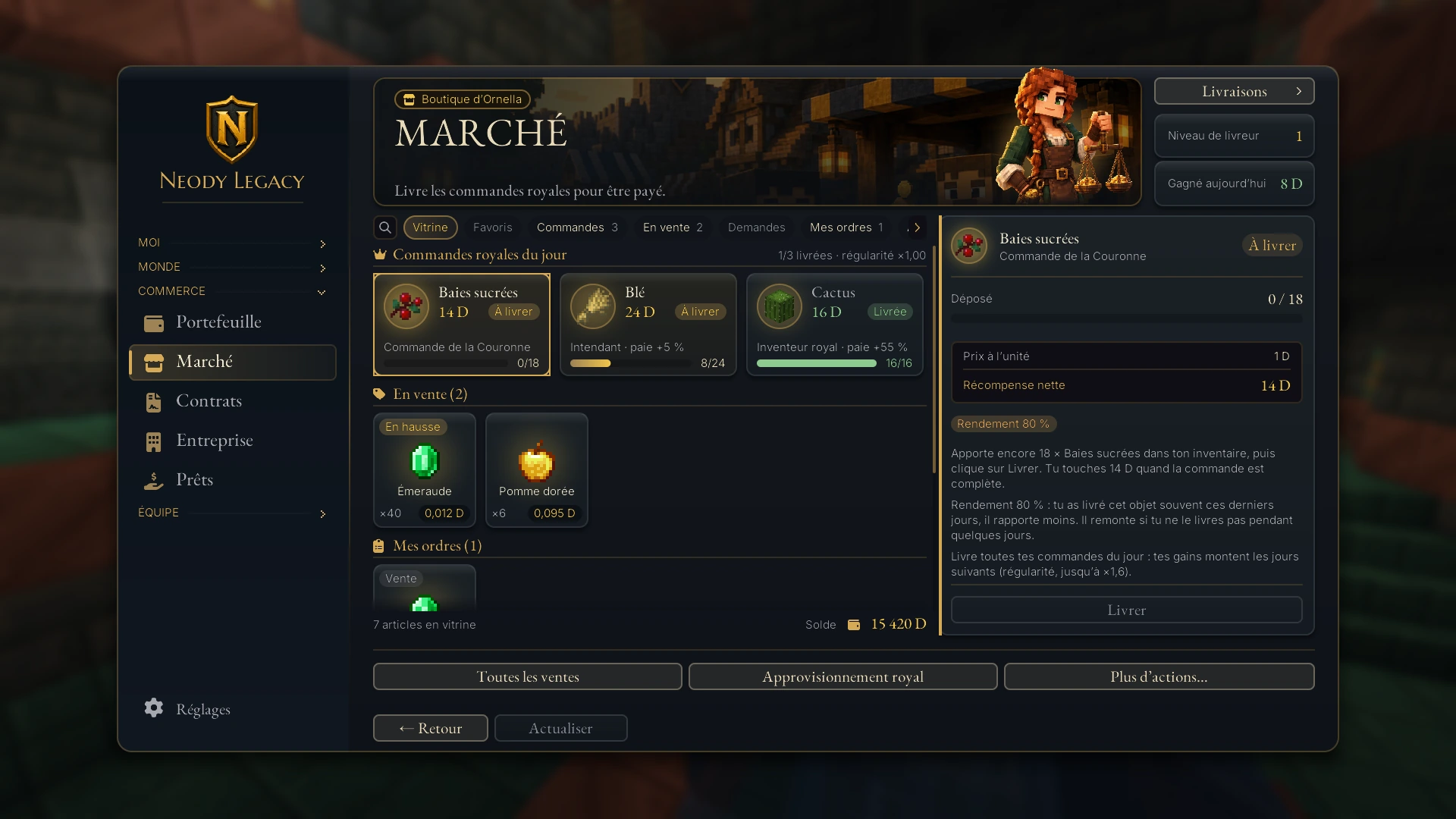
Royal Orders : the Crown buys items from you at the day's prices. The main source of new deniers, and therefore your first shop with roles reversed: you sell. Details in Royal Orders.
Royal Supply : the Crown sells basic materials (stone, dirt, wood…) at prices following demand. It is your building project's safety net. Details in The Market and Royal Supply.
Player Market : sell surplus and buy missing items from other players at their prices. See the same guide above, Market section.
Why three stalls: the denier cycle
The three stalls form a cycle. Royal Orders create deniers from your work; the player Market circulates them between purses; Royal Supply removes them from circulation, as money spent there disappears. Without the first, currency would have no source; without the last, it would lose value as everyone grew richer.
| Royal Orders | Market | Royal Supply | |
|---|---|---|---|
| The Crown's role | It buys items from you | None: players trade with each other | It sells materials to you |
| Your deniers | You earn new ones | They change hands | They are spent, then destroyed |
| Who sets prices | The royal price list | Players, order by order | The current price, following demand |
| Frequency | 3 orders per day | Whenever you like | Whenever you like |
Remember the beginner's golden rule: earn first, spend afterwards. Start your day with your three orders, fund stopgap purchases from their earnings, and use the player Market to sell what remains.
Your first days: supporting a new colony
You arrive with little: a Supply Camp for your colony, 9 loaves and 8 raw rabbits. No starting balance or welcome parcel of deniers: your first money comes from work. This order works well.
1. Found your colony
Check the current founding limits, then place your Supply Camp and Town Hall. The full process is in Getting started with your colony.
2. Open your Royal Orders
From your first connection, you can fulfil orders without linking Discord, using a trial allowance (5,000 D gross in total, with no time limit). Once it runs out, linking is required to continue: see Linking your Discord.
3. Identify the real shortfall
Before buying anything, check what is actually missing: the red cog on your Builder's Presse-papiers (Clipboard) tells you which material is holding up construction.
4. Fill the gap with Royal Supply
Need sand, cut stone or logs, with nobody selling? Use the Crown's stall. A batch holds at most 64 items, and the quote lasts only a few seconds.
5. Replace the purchase with production
A purchase fills a gap; a production line solves it: farm, sawmill or machinery chain. If you buy the same batch every evening, your economy has a leak.
6. Sell your surplus
Once your huts are running, the player Market absorbs spare farm, mine and workshop output.
When the Crown sells: Royal Supply
“Approvisionnement royal” (Royal Supply) is at the bottom of the Market. The “Dépôt d'Aubin · Intendant” (Aubin's depot · Steward) screen displays its motto: “Ici, la Couronne vend. Le cours suit la demande.” (Here, the Crown sells. Prices follow demand.)
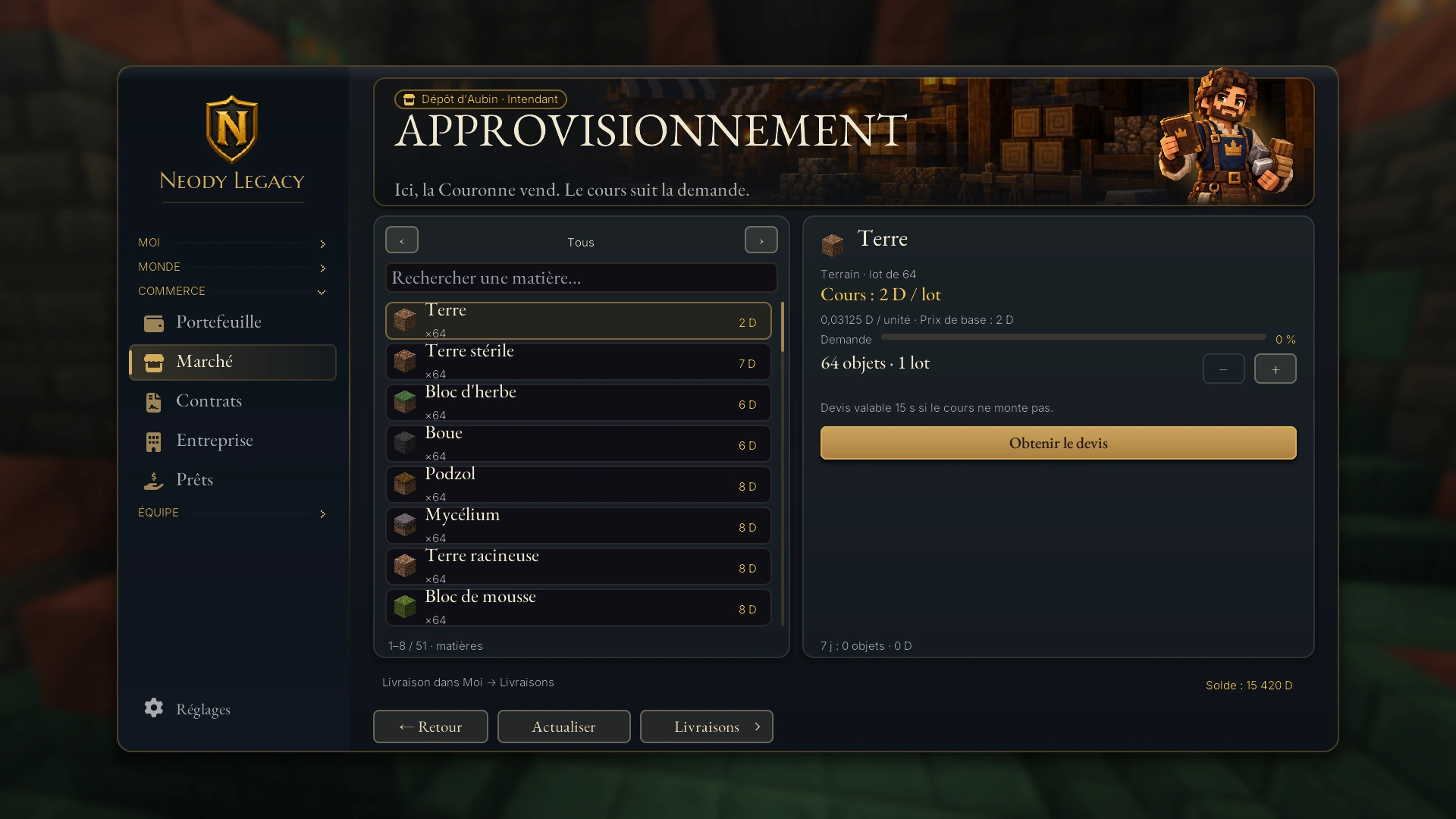
- What you find there : basic materials (ground, wood, stone, Nether and End materials, snow and ice, some simple ores). Precious metals and redstone remain the players' trade.
- Prices move : each purchased band adds 50% to the price, the surcharge halves every 24 hours, and the price never exceeds three times its base. Spread large purchases over several days.
- The quote : “Obtenir le devis” (Get a quote) fixes a price briefly, followed by “Confirmer l'achat” (Confirm purchase). Items arrive in Moi › Livraisons, where “Récupérer” (Collect) moves them into your bag.
- Money spent disappears : nobody receives it, keeping the Kingdom's currency balanced.
Kingdom rhythms to remember
- Seasons follow real-world time, roughly a week per season. Winter empties your growing calendar: stock up before it arrives rather than rushing to Royal Supply on the first snowy morning (see the world guide).
- Barbarian raids occur on average every 10 to 14 nights. Buying arrows and bread beforehand helps, but does not replace a barracks: see the raid guide.
- Royal Orders change daily: three orders, an earnings cap of 5,000 D per player per day, and a rank that rises over time.
- Your colony has its own accounts : budget, income and spending are managed in your colony treasury, separately from your personal purse.
Trading between players
At the Market, place buy or sell orders at your own price, or buy and sell immediately against the best existing order. For more structured exchanges (scheduled deliveries, services and loans), see contracts, companies and loans. To understand the currency, coins and transfers: Deniers, the currency of the Kingdom.
- Market tax : the Market charges 5.5%. Whoever fulfils an existing order pays it: an incoming buyer pays price plus tax; an incoming seller receives price minus tax.
- Clear adverts : item, quantity, place and deadline, rather than “selling iron, DM me”.
- Protect your trade counter : a chest outside any protected territory relies entirely on your vigilance. Rented territories provide real protection: see Territories, protection and disputes.
- Trade between colonies has its own tools (routes, treaties, reparations): War and peace.
Common mistakes
| Symptom | Actual cause | Remedy |
|---|---|---|
| “I cannot find a merchant” | There is none: everything uses the menu | Press K › Commerce › Marché |
| I see no orders today | No price-list item for your rank, or trial allowance exhausted without Discord linked | New round tomorrow; link your Discord |
| My purchase is not in my bag | It arrives in Livraisons | Moi › Livraisons › “Récupérer” (Collect) |
| The price rose within minutes | Demand surcharge at Royal Supply | Spread purchases or look for player offers |
| A batch is refused | The Market refuses orders for damaged or renamed items or filled shulker boxes | Choose fresh items |
Trade counter FAQ
- Does the shop replace my huts? No. It fills gaps until your production lines are running.
- Which command opens the shop? None: press K to open the menu; the Ctrl+K palette takes you to the right screen with a few letters.
- What is the currency called? The denier, written D.
- Will prices change? Royal Supply prices follow demand, and the staff may adjust some settings. The confirmation screen immediately before you approve is definitive.
- Can I still barter with another mayor? Yes, through the Market, a contract or in person: this is trade between towns.
- Does my colony's rank give money? No: it is an indicator of your town, not a currency.
Your first week as a trader
The K menu open, Marché tab explored
Three Royal Orders fulfilled each day
Royal Supply purchases only for genuine needs
A production line started for each recurring purchase
Deliveries collected, room in your bag
Food reserves ready before winter
The Crown buys, the Crown sells, the Kingdom trades: choose the stall that moves your colony forward.